
Abstract:
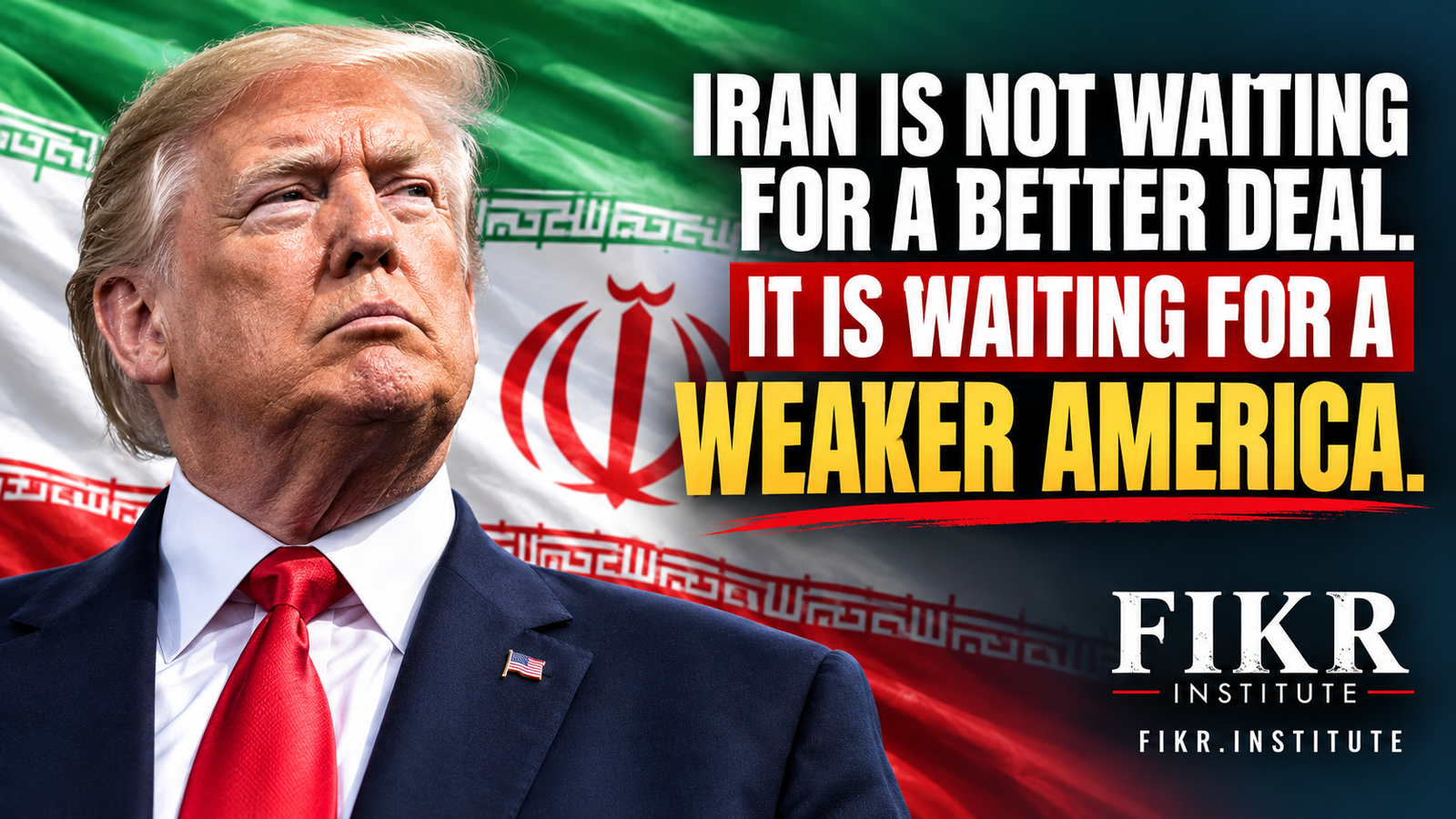
Six months into a war that began on 28 February 2026, the United States has exhausted its practical options against Iran. Escalation lacks domestic support, withdrawal would register as defeat, and a negotiated settlement is unavailable because Iranian negotiators have no reason to trade present concessions for future American promises. What remains is assertion, and on 18 August the American president posted a map claiming the Strait of Hormuz as American territory while his envoy and he contradicted each other within twenty four hours on whether talks existed at all. This analysis argues that Iranian strategy is no longer aimed at the terms of any agreement. The objective is the demonstration that American power can be outlasted, a demonstration that is permanent, visible to every other state, and purchased with time rather than blood. If that is correct, no concession changes Iranian behaviour, because ending the stalemate is a cost rather than a benefit.
Main Article:
A state announces sovereignty over territory it cannot control only when it has run out of ways to control it. The announcement is not the exercise of power. It is what remains after the exercise of power has been tried.
On Friday 14 August, speaking at a police academy event on Long Island, the American president said that after the defeat of Iran he would shortly be declaring the Strait of Hormuz a territory of the United States [1]. Asked about it in the Oval Office on Monday, he said he liked the idea and claimed the United States already controlled the waterway through its naval blockade [2]. On Tuesday morning he posted a map on his own platform with a circle drawn around the strait and a header reading new US territory, presented without further comment [2][3].
The strait lies in the territorial waters of Iran and Oman. Around a fifth of the oil traded in the world passes through it. It has been closed or restricted by Iran since the war began, and the Iranian parliamentary speaker stated that it will remain closed until the American blockade is lifted, frozen Iranian assets released, oil sanctions removed and military operations ended on all fronts [3]. The Iranian deputy foreign minister replied to the map by saying the strait had been Iranian, was Iranian and would remain Iranian, and that it would open and close on Iranian command [2].
Consider what the map is doing. It asserts ownership of the one thing the United States has been unable to reopen after six months of war, a naval blockade and repeated strikes on Iranian territory. Sovereignty is being claimed over precisely the object of the failure.
To see why that is the only move left, look at what the alternatives now cost.
The first alternative is escalation. It is unavailable at acceptable political cost. Polling published on 17 August put presidential approval at 33 percent against 64 percent disapproval, the lowest of the current term. Eighty percent of Americans, including 71 percent of Republicans, expect the involvement in Iran to continue for an extended period. Around 35 percent support the war and roughly one in five believe it has been worth it [4][5]. Congressional elections follow in November.
The second alternative is withdrawal. It ends the economic damage but registers, in every capital watching, as a superpower leaving a war it started because it could not finish it.
The third alternative is a negotiated settlement, and this is the one that matters, because it was tried and it failed in a way that is instructive.
On 17 June the two presidents signed a fourteen point memorandum, brokered by Pakistan and agreed after the failure of talks in Islamabad in April. It provided for permanent termination of military operations on all fronts including Lebanon, an end to the American naval blockade within thirty days, withdrawal of American forces from Iranian proximity once a final deal was reached, and a reconstruction package for Iran of at least three hundred billion dollars. It opened a sixty day window for a final agreement [6].
On 8 July, three weeks after signing, Iran struck commercial shipping in the strait to assert its sovereignty there, the United States struck Iranian territory in response, and the American president declared the memorandum over. Iran formally suspended its commitments on 18 July. Between 8 and 24 July the two exchanged strikes, with Iran hitting American facilities in Jordan, Bahrain and Kuwait. The sixty day deadline expired on 17 August with the two sides deadlocked over control of the strait and over the frozen funds [6][7].
Here is the mechanism that closed the third option permanently.
A negotiated settlement requires one side to give something now in exchange for something promised later. That trade is only possible if the promise is believed. An administration that declared a signed agreement void three weeks after signing it has established, as a matter of demonstrated record, that its commitments do not survive contact with events. Iranian negotiators are not being stubborn when they refuse to move first. They are pricing observed behaviour.
The disarray is now visible without any need for inference. On Monday 17 August the presidential envoy said publicly that the United States and Iran were engaged in positive and active conversations. On Tuesday the president wrote that there were no talks or conversations under way or scheduled, and that the blockade remained in full force. In the same period he claimed a back channel to the Islamic Revolutionary Guard Corps, which Iranian officials denied [3][8].
That contradiction, twenty four hours apart and between a president and his own envoy, is not a scandal. It is a symptom. No foreign government can currently determine what American policy is by asking the Americans.
Which brings us to the part that is least discussed and matters most.
The conventional reading is that Iran is holding out for better terms. That reading assumes the terms are the objective. There is strong reason to think they are not.
Iranian conditions have not moved since June. The demands stated in August are the provisions already contained in the memorandum signed in June. A party seeking better terms improves its asking price when its opponent weakens. Iran has not. It has simply repeated itself while the other side deteriorates.
That behaviour is consistent with a different objective. What Iran is accumulating is not leverage over the text. It is the public record of a superpower that opened a war, could not close it, could not reopen a strait, could not hold its own agreement together for a month, and finally resorted to posting a map.
That record is worth more than any clause, for three reasons.
It is permanent. Sanctions can be reimposed and assets refrozen, but a demonstration of exhaustion cannot be withdrawn once it has been made.
It is universal. It is not addressed to Tehran but to every government now recalculating what an American commitment is worth, including those hosting American forces, those relying on American guarantees, and those competing with American power elsewhere.
And it is cheap relative to the alternative. It is being bought with time, which Iran has, rather than with escalation, which would risk the regime itself.
If that is the objective, then the standard policy prescriptions fail on their own logic. Offering better terms does not work, because ending the stalemate ends the demonstration and therefore subtracts from the thing being accumulated. Threatening escalation does not work, because escalation the adversary can absorb adds to the demonstration rather than reducing it. And promising restraint does not work, because promises are the specific currency that has already been devalued.
Honesty requires the counterweight, because this is not a case of one side simply winning. Iran is paying heavily. Its supreme leader was killed in the opening strikes. Its economy is under blockade, its assets are frozen and its infrastructure has been struck repeatedly. The demonstration is being purchased at a price that any state would prefer not to pay, and a regime under that pressure can miscalculate or fracture. Nothing here forecasts an Iranian triumph.
The claim is narrower. It is that the asymmetry of stakes determines the asymmetry of endurance. For the United States this was a war of choice with no urgency behind it. For the Iranian state it is a question of survival. The party for whom the outcome is existential will pay more and wait longer, and this is not a novel observation but the oldest pattern in the record of great powers fighting smaller ones far from home.
Britain learned it in 1956. The Suez operation was launched to assert a right over a waterway that Britain believed it still possessed. Financial pressure ended the operation within weeks. The canal was never the lasting loss. The lasting loss was that every government watching revised its estimate of British power downward, permanently, and organised its future dealings accordingly. The assertion intended to demonstrate strength became the evidence of its absence.
A map posted to a social media account is a smaller thing than an invasion fleet. The function is identical. Both are declarations of a right that the declaring power can no longer enforce, issued at the moment enforcement has failed, and both are read correctly by their audience.
The strait is not the subject of this war any longer. Neither is the nuclear programme. What is being contested is the answer to a single question that every state in the region and beyond is now asking, which is how long the United States can be made to hold a position it has already found too expensive.
The answer is being determined in public, on a timetable set by whoever is willing to wait longest.
References:
1. The Media Line, report on the presidential statement on Long Island regarding the Strait of Hormuz and the threat against Oman.
2. The Hill, report on the map posted on 18 August 2026 and the Iranian official response.
3. Forbes, report on the map, the expiry of the sixty day deadline and the conditions stated by the Iranian parliamentary speaker.
4. Reuters, polling conducted with Ipsos between 14 and 17 August 2026 on presidential approval and expectations of the war.
5. Forbes, summary of comparative polling on approval and support for continued military action.
6. Al Jazeera, analysis of the June memorandum of understanding, its provisions and its collapse.
7. Middle East Monitor, reporting on the ceasefire, the exchange of strikes in July and the approach of the August deadline.
8. South China Morning Post, report on the contradiction between the presidential envoy and the president regarding talks with Iran.