
Abstract:
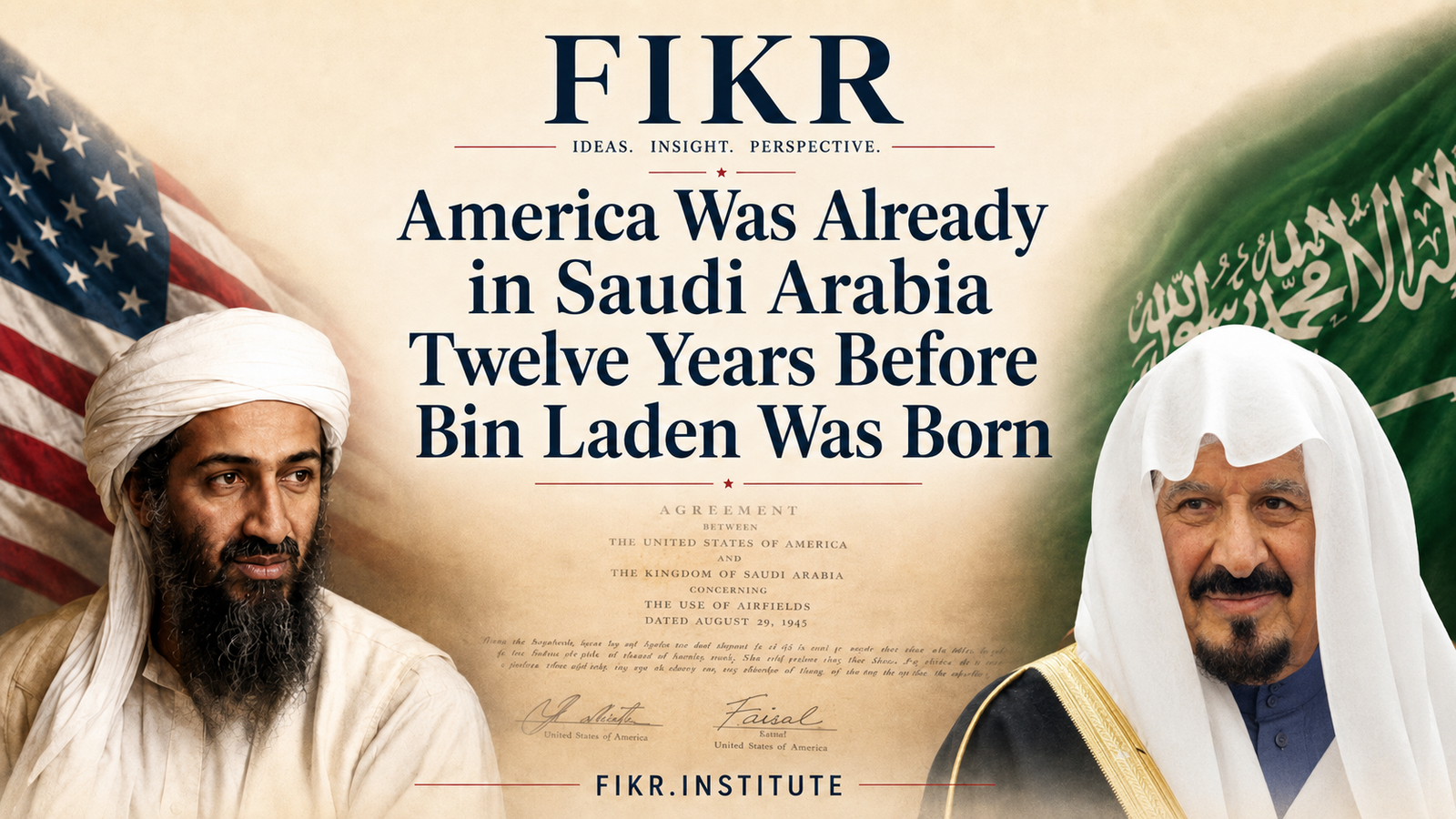
The standard account of the origins of al Qaeda treats August 1990 as the decisive moment, when the Saudi state turned down an offer from Osama bin Laden to defend the kingdom and accepted an American deployment instead. The diplomatic record does not support that framing. The security relationship that placed foreign forces on Saudi soil was negotiated between 1944 and 1945, authorised by the Joint Chiefs of Staff, approved by the American president and agreed with the king in August 1945, twelve years before bin Laden was born. By the time he arrived at the Defence Ministry in Riyadh in September 1990, American aircraft had already been landing for a month and a senior religious official had been brought in to explain why their presence was lawful. He was not competing for a decision. He was petitioning against infrastructure. This analysis examines what the sequence reveals about where the security of the Saudi state had been located for two generations, and why the presence outlasted every threat used to justify it.
Main Article:
A state does not choose its protector in the middle of a crisis. It chooses years earlier, in quiet agreements signed when nothing is burning, and the crisis only reveals what was already chosen.
In 1933 the government of Saudi Arabia granted an oil concession to the Standard Oil Company of California, and a subsidiary was created that November to manage it. Five years of drilling produced almost nothing. The company considered abandoning the venture. Then on 3 March 1938 a well at Dammam struck oil in commercial quantity, and within weeks it was producing thousands of barrels a day [1]. A kingdom that had lived on pilgrimage revenue and dates now sat above the largest proven reserves on earth.
That is usually told as an economic story. It was a security story from the beginning.
By 1944 the War Department in Washington wanted an airfield at Dhahran, beside the oil. In March 1945 the Joint Chiefs of Staff concluded that there was military necessity for it, valuing the site as a staging point between Cairo and Karachi that would shorten the air route by roughly two hundred miles [2]. The American minister at Jidda put the request to the king directly, and the language preserved in the diplomatic record is exact. Landing strips and necessary buildings and installations. Flying rights across the country. Permission for American military forces to locate, construct, maintain and remove navigational aids. One emergency field in central Saudi Arabia.
The king consented. Agreement was reached on 6 August 1945. Construction began that January and the American installation was activated the following month [3].
Two conditions were attached, and both repay close reading. The airfield and its fixed installations would revert to the government of Saudi Arabia at the end of the war, and American forces would remain for a term of three years afterward. As part of the same arrangement, the United States undertook to train the Saudi military, which became the foundation of the mutual defence relationship that followed [3].
Read those terms again and notice what each side kept. The Saudi state kept ownership. It did not keep capability.
That distinction is the whole architecture. A state that owns a base but cannot operate its defence without the country that built it has not hosted a guest. It has entered a dependency, and every later decision runs along the shape of that dependency rather than against it. The three year term became a permanent relationship, expanded through arms sales, training missions and successive agreements across four decades.
The temporary presence lasted fifty eight years.
On 2 August 1990 Iraq invaded Kuwait. Five days later, at the request of King Fahd, the American president ordered forces to Saudi Arabia, and the first fighter aircraft landed the same day. The deployment grew into the largest American overseas commitment since Vietnam.
Only after that did Osama bin Laden go to the Defence Ministry in Riyadh.
He arrived in September 1990 carrying military maps and diagrams, and told the defence minister, Prince Sultan, that he could raise a hundred thousand fighters within three months and that there would be no need for non Muslim troops [4]. The reply has been reported consistently. There are no caves in Kuwait, the prince told him, before asking what he intended to do when Saddam Hussein fired chemical and biological weapons at his men. Bin Laden answered that they would fight with faith [4][5].
The exchange is usually presented as the hinge of everything that came after. It is worth asking what was being decided in that room.
Nothing was. American aircraft had been operating from Saudi bases for a month. The coalition was assembling. And according to the fullest account of the meeting, a senior official of the Muslim World League attended in order to explain to bin Laden that the troops already invited carried religious sanction. A cleric is summoned to justify a decision, not to help reach one. The purpose of the meeting, from the side of the state, was to close an argument rather than to weigh an offer.
He was not turned down in favour of the Americans. He was refused a decision taken twelve years before he was born.
This matters for what it reveals rather than for what it excuses. The Saudi state did not conclude in the summer of 1990 that foreign forces were more reliable than its own citizens. It had concluded that in 1945 and had spent forty five years building the institutions that made the conclusion irreversible. When the test came, there was no deliberation left to hold. The relevant question had been settled by men who were dead.
The record of the years that followed shows how completely the presence had detached from any particular threat. Bin Laden left the kingdom, was stripped of citizenship, and in August 1996 issued a declaration whose entire organising grievance was the stationing of American troops on the peninsula, published from London in an Arabic newspaper [6][7]. The document ranges across Islamic history and a long list of complaints, but its title and its central demand concern the presence and nothing else.
The presence remained through the decade. It was still there after the threat that justified it had been contained, still there through the enforcement of the no fly zones, still there when the argument for it had thinned to habit.
It ended on 29 April 2003, when the American defence secretary stood in Riyadh beside the same Prince Sultan and announced the withdrawal of around seven thousand personnel, saying the region was safer because Iraq had changed, with roughly four hundred remaining to train Saudi forces [8]. The government of Saudi Arabia had refused to let American aircraft strike Iraq from its bases during that war.
Consider what that sequence establishes. The deployment was justified in 1990 by an Iraqi army on the border. It survived the destruction of that army by twelve years. It was dissolved within weeks of the fall of Baghdad, at a moment when the host state had just declined to let it be used. A presence that outlives its stated cause by more than a decade and then ends the instant it becomes politically expensive was never primarily about the cause.
There is a reason states prefer to describe such arrangements as responses to emergencies. An emergency has an end. An architecture does not.
The kingdom did not choose America over its own son in 1990. It had chosen in 1945, in an agreement that traded ownership for capability and called the result temporary. Everything after that was administration.
References:
1. Aramco, corporate history of the 1933 concession agreement and the Dammam No. 7 discovery of 3 March 1938.
2. United States Department of State, Foreign Relations of the United States, 1945, Volume VIII, documents on the proposed military airfield at Dhahran.
3. United States Army, historical account of the Dhahran Airfield Agreement of August 1945 and subsequent construction and training provisions.
4. NPR, retrospective reporting on the first Gulf War and the September 1990 meeting between Osama bin Laden and Prince Sultan.
5. Royal United Services Institute, review essay on al Qaeda before the September 2001 attacks.
6. Foreign Policy Research Institute, account of the August 1996 declaration and its publication in Al Quds Al Arabi.
7. National Commission on Terrorist Attacks Upon the United States, report chapter on the foundation of the new terrorism.
8. United States Department of Defense, transcript of the joint media availability in Riyadh, 29 April 2003.