
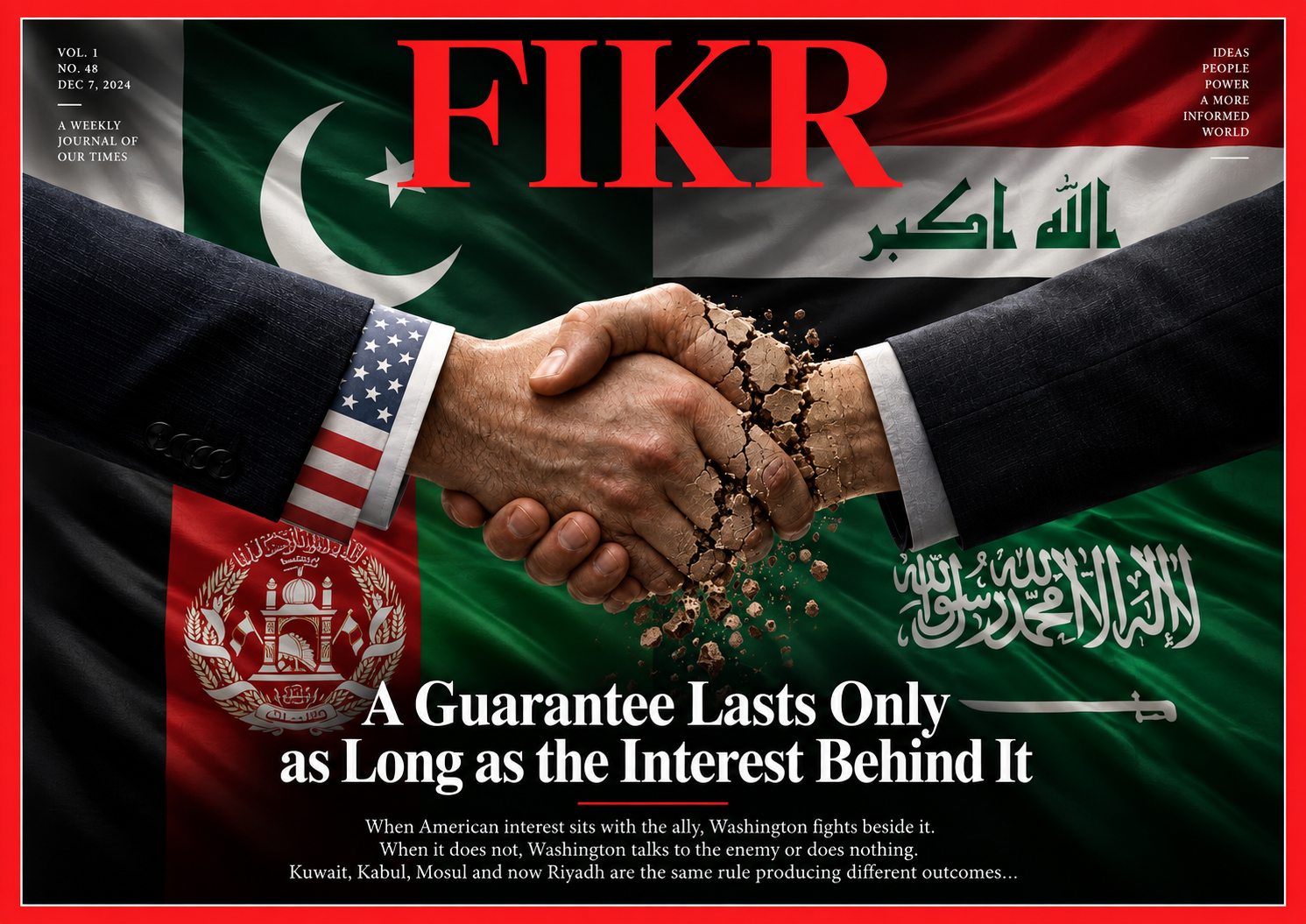
Abstract:
In September 2026, Saudi Arabia asked Washington for strikes on the Houthis and was refused. American officials met Houthi representatives in Muscat and kept an understanding with them while the Kingdom was under fire. This article argues that the pattern is not inconsistency but a single rule: the United States acts on American interest, and the partner only benefits when its own survival happens to sit on the same side of that calculation. Iraq tested American intentions in July 1990 and met ambiguity, and Washington fought a year later when control of Gulf oil was at stake. Baghdad asked for air strikes against ISIS in May 2014 and was refused, and strikes began in August only when American personnel in Erbil were threatened. Kabul signed an enduring partnership and Washington later negotiated its exit with the Taliban. Pakistan was armed while the Soviets were in Afghanistan and cut off once they left. The article concludes that changing the guarantor changes nothing, and that only a regional arrangement can remove the pattern.
Main Article:
A great power defends its interests. It defends an ally only for as long as the ally stands on the same side of that calculation, and when the two part company the ally discovers what the guarantee was made of.
Saudi Arabia found the answer this month. When the Crown Prince asked President Trump for military support against the Houthis, he was told Washington would not become directly involved. [1] American officials met Houthi representatives at the embassy in Muscat and reaffirmed the understanding that neither side would attack the other, while the Kingdom was under attack. [1] The United States sent more than 100 advisers with intelligence and targeting data, took no part in the strikes, and did not refuel Saudi aircraft as it had in earlier rounds of this war. [2] Days later it was Britain that sent one tanker for defensive refuelling over Saudi airspace. [3] Riyadh has bought American aircraft, American air defences and American training for fifty years, and when it asked for the one thing that mattered, Washington was at the table with the other side.
That is not an exception. It is the rule, and the rule has three outcomes.
The first outcome is that Washington fights, when the interest is its own. In 1990 Iraq massed two Republican Guard divisions on the Kuwaiti border. The national intelligence officer for warning at the time, Charles Allen, later wrote that the movement was confirmed by technical means on July 21, that a large logistical buildup was detected on July 23, and that on July 25 he issued a warning of war memorandum putting the chances of an Iraqi incursion at better than 60 percent. [4] The wider intelligence community did not agree, judging on July 31 that no major action was likely. [4] On the day the warning memorandum was written, Saddam Hussein summoned the American ambassador, April Glaspie. In the Iraqi transcript of that meeting, published by The New York Times that September, she told him: "But we have no opinion on the Arab-Arab conflicts, like your border disagreement with Kuwait," and urged a quick settlement through Arab mediation. [5] Glaspie later disputed the accuracy of that transcript, which is an Iraqi document and the only published account of the meeting. Fikr Institute does not claim that Washington invited the invasion, and no public evidence establishes that it did. What is documented is that specialist warning of an imminent attack sat inside the American government in the same week that its ambassador told the Iraqi president that Washington took no position on the dispute. Iraq invaded eight days later.
The courtship around that meeting is documented on the American side, not the Iraqi one. In her own cable reporting the meeting, released in 2011, Glaspie recorded that the President had instructed her to broaden and deepen relations with Iraq, and that President Bush wanted friendship. [6] Three days later, on July 28, with the Republican Guard divisions still on the Kuwaiti border, President Bush sent a personal message to Saddam Hussein. The State Department later confirmed the message and refused to release its text, saying only that it sought a peaceful settlement of the dispute with Kuwait and that communications between heads of state are privileged. [7] So the sequence is this. Washington had warning of an attack, it told the Iraqi president it had no position on the dispute, and then, with the army still massed, the President of the United States wrote to him seeking closer relations. Five days after that letter the tanks crossed.
Then the calculation changed. With Iraqi forces holding Kuwait and sitting on the Saudi border, the oil system of the Gulf was in question, and Washington assembled a coalition and expelled the Iraqi army in 1991. [8] The liberation of Kuwait was real. So was what followed: American forces did not leave, and in February 1992 a draft Defense Planning Guidance prepared in the Pentagon set out the objective of preventing the reemergence of a new rival to American power. [9] The crisis that began at the Kuwaiti border ended with a permanent American military architecture across the region.
The second outcome is that Washington does nothing, when the ally is losing but American interests are not yet touched. In May 2014 the Iraqi government asked the United States for air strikes against the fighters who would soon be called Islamic State, and the request was refused. [10] Mosul fell in June. The strikes began on August 7 and 8, after the advance reached Erbil, and the president explained them in those terms, authorising action to stop the advance on the city and to protect American personnel and facilities, including the consulate in Erbil and the embassy in Baghdad, together with the civilians trapped on Mount Sinjar. [11] The Iraqi state had been asking for months. What moved the aircraft was the danger to Americans.
The third outcome is that Washington deals with the enemy of its ally. Afghanistan is the clearest case. In 2012 the two states signed an Enduring Strategic Partnership Agreement, under which the United States undertook to regard aggression against Afghanistan with grave concern and to consult urgently on political, diplomatic, economic or military measures. [12] The security agreement of 2014 gave American forces access to Bagram, Kandahar, Jalalabad, Mazar-e-Sharif, Herat and other facilities. [13] On February 29, 2020, Washington signed an agreement with the Taliban providing for the withdrawal of American and allied forces. The Afghan government was not a party to it. [14] The withdrawal was completed on August 30, 2021. Kabul had fallen fifteen days earlier. Washington spent about $145 billion over twenty years on Afghan forces, institutions and reconstruction, [15] and ended its war by negotiating with the force it had spent that money to defeat. Muscat in 2026 is Doha in 2020 with different names.
Pakistan shows the same rule on a longer clock. American assistance ran until the war of 1965, when Washington suspended arms shipments to both Pakistan and India, an embargo that held through the war of 1971 and was not lifted until 1975. [16] When the Soviet army entered Afghanistan, Pakistan became indispensable, and in June 1981 the Reagan administration announced $3.2 billion over six years, including F-16 aircraft, followed in 1986 by about $4 billion more after the president certified that Pakistan did not possess a nuclear explosive device. [17] The Soviet withdrawal was completed in February 1989. In October 1990 the president declined to certify again, assistance was terminated under the Pressler Amendment, $564 million in new aid was frozen, and 28 F-16 aircraft that Pakistan had already paid for were withheld. [17] What changed was not the Pakistani nuclear programme, which American intelligence had already assessed. What changed was the value of Pakistan.
The money proves the point rather than answering it. The same American review that recorded the $145 billion found that after a decade of drawdown the Afghan government remained dependent and vulnerable. [15] Equipment is not autonomy. An advanced aircraft without independent intelligence, munitions stocks, maintenance, trained command and the political power to decide when to use it remains an extension of the state that supplied it. Saudi Arabia owns one of the most expensive arsenals in the world and could not buy the one decision it wanted this month.
Nor does a different patron solve anything. A Chinese guarantee would serve Chinese interests and a Russian guarantee would serve Russian ones, exactly as an American guarantee serves American interests. Changing the guarantor leaves the structure untouched and only changes whose calculations decide the fate of the region.
The alternative is an arrangement among the states of the region, and it is harder than any purchase order. It does not require friendship. It requires rules that bind: on attacks against energy infrastructure and shipping, on armed groups operating across borders, on missiles and drones, on airspace, on notification of exercises, on direct lines between militaries in a crisis, and on an agreed method for investigating attacks whose author is disputed, of which this war has produced several.
Any such arrangement runs into Iran, and there is no honest way around it. Iranian missiles, armed partners across the region and interventions in neighbouring states are a large part of why Gulf governments arm themselves and why foreign fleets are welcome. From Tehran the picture appears in reverse: American bases, Western fleets, Israeli power and heavily armed neighbours. Each side takes the step that makes it safer and its rival more afraid, and each round brings more foreign forces in. An arrangement that excludes Iran leaves that cycle running. An arrangement that includes Iran faces problems of trust and enforcement that no communique will solve. Fikr Institute does not present this as easy. It presents it as the only version of the problem that the states of the region can solve themselves.
A great power defends its interests. Baghdad learned it in 1990 and again in 2014, Kabul learned it in Doha, Islamabad learned it when the Soviets went home, and Riyadh learned it this month while Washington sat with the Houthis in Muscat.
It is the judgment of Fikr Institute that the United States defends American interests and nothing else, and that its partners receive protection only in the periods when their survival and those interests point the same way. When the interest sits with the ally, Washington fights beside it. When it does not, Washington talks to the adversary or stands still and lets the ally bleed. This is not treachery and it is not an accident, which is precisely why no appeal, no arms purchase and no signed partnership will change it. The states of this region hold the oil, the ports, the airfields and the money, and they have spent decades buying the appearance of protection while leaving the decision abroad. Until they build their own capability and their own binding arrangements, including with the neighbour they fear most, they will keep waiting for a decision that is made in another capital, for another country.
References:
1. Reuters, "US Officials Met Houthis in Oman over the Weekend, Sources Say," September 16, 2026.
2. CNN, "US Expands Intel, Targeting Support for Saudi Campaign against Iranian Ally," September 10, 2026.
3. The National, "Britain to Send RAF Refuelling Tanker to Bolster Saudi Air Defences," September 22, 2026.
4. Charles E. Allen, "Warning and Iraq Invasion of Kuwait: A Retrospective Look," Defense Intelligence Journal, volume 7, number 2, 1998.
5. The New York Times, "Excerpts from Iraqi Document on Meeting with U.S. Envoy," September 23, 1990. Note: this is the Iraqi transcript of the meeting, whose accuracy the ambassador later disputed.
6. Foreign Policy, Stephen M. Walt, "WikiLeaks, April Glaspie, and Saddam Hussein," January 9, 2011, citing the July 25, 1990 embassy cable released in 2011.
7. The Washington Post, "Bush Dealings with Saddam Questioned," October 20, 1992. Note: the State Department confirmed the July 28, 1990 message and declined to declassify its text.
8. Office of the Historian, U.S. Department of State, "The First Gulf War," Milestones in the History of U.S. Foreign Relations, 1989 to 1992.
9. National Security Archive, "The Making of the Cheney Regional Defense Strategy, 1991 to 1992," Electronic Briefing Book 245.
10. Al Jazeera, "Iraq Maliki Appealed for US Air Strikes," June 12, 2014, citing The New York Times.
11. The White House, "Statement by the President," August 7, 2014.
12. Enduring Strategic Partnership Agreement between the United States of America and the Islamic Republic of Afghanistan, May 2, 2012.
13. Security and Defense Cooperation Agreement between the United States of America and the Islamic Republic of Afghanistan, September 30, 2014.
14. Agreement for Bringing Peace to Afghanistan, United States and the Taliban, February 29, 2020.
15. Special Inspector General for Afghanistan Reconstruction, "What We Need to Learn: Lessons from Twenty Years of Afghanistan Reconstruction," August 2021.
16. Stephen P. Cohen, "Pakistan and the Cold War," in Superpower Rivalry and Conflict, edited by Chandra Chari, Routledge, 2010.
17. Peterson Institute for International Economics, Case 79-2, "US v. Pakistan, 1979 to 1998, Nuclear Weapons."