
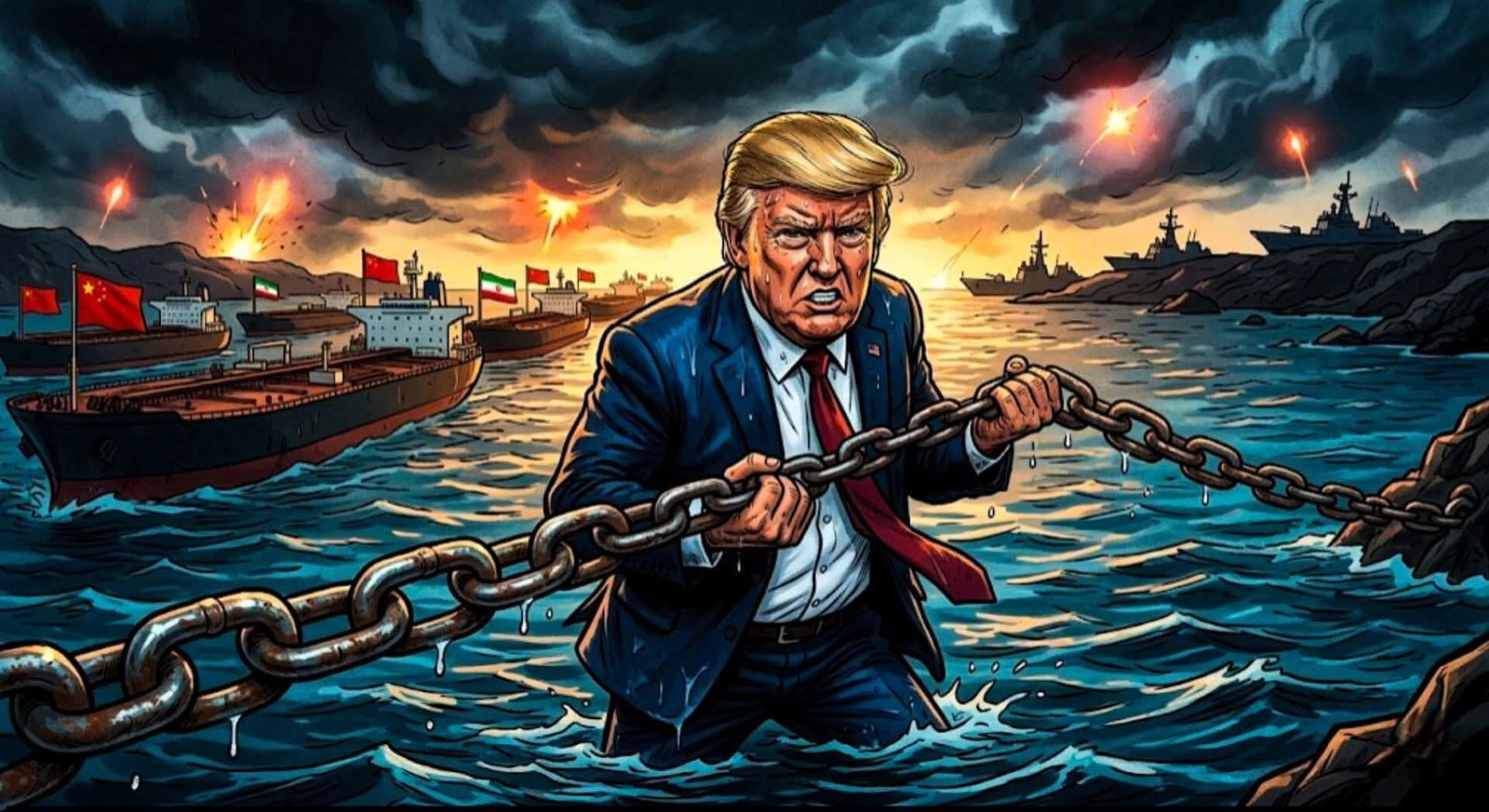
There is a pattern in the late stages of a failing campaign that historians have documented across enough wars to give it a name. When military force has not produced political submission, and when negotiation has not produced agreement, the state that cannot accept either outcome reaches for a third instrument that is neither fully military nor fully diplomatic. It is coercive. It is designed to inflict enough pain to force a recalculation. And it almost always misreads what the adversary's pain threshold actually is, because states that have already survived the worst have already demonstrated that their threshold is higher than the threatening party assumed.
The US naval blockade of Iranian ports, which took effect at 10 a.m. Eastern Time on Monday April 13, 2026, is that instrument. (1) It came sixteen hours after Trump fell silent following the collapse of Islamabad talks and then erupted in a sequence of social media posts and a Fox News interview announcing a complete interdiction of all vessels entering or departing Iranian ports and coastal areas. (2) The blockade began the same day Iranian officials called it an act of piracy, (3) oil prices crossed 100 dollars per barrel again, (4) and the UK, Spain, and France separately announced they would not participate, with France and Britain instead organizing a conference on restoring freedom of navigation through a civilian multinational mission. (5)
The confusion embedded in this decision is its most revealing feature.
Iran has been blocking the Strait of Hormuz since February 28, the first day of the war. It has allowed passage selectively, permitting Chinese, Indian, and Pakistani vessels at prices reported at up to two million dollars per ship while excluding vessels from states it defines as combatants. (6) Iran has earned approximately 1.5 million barrels per day in oil exports through this arrangement, approximately 100,000 barrels more per day than it was exporting before the war began. (7) The ceasefire agreement of April 7 was explicitly conditioned on Iran reopening the strait to general passage. Iran accepted the condition in its announcement but then continued operating its selective transit regime, citing Israeli strikes in Lebanon as ceasefire violations that released it from its commitments.
The practical consequence was that Iran was profiting from controlling a waterway it had nominally agreed to open, while the United States watched the tolls accumulate and the ceasefire's core objective go unmet.
Trump's stated purpose for the blockade is to deny Iran this revenue. "It's going to be all or none," he told Fox News. (8) The CENTCOM clarification that followed, however, revealed the actual scope of the action. The blockade will not impede vessels transiting the strait to and from non-Iranian ports. It applies only to vessels entering or departing Iranian ports and coastal areas. (9) In other words, the United States announced a complete blockade and then immediately clarified that the strait itself would remain open to everyone except Iranian commerce. What Trump described as flipping the dynamic of Iranian control is, in operational terms, a counter-toll regime in which American warships do what Iranian IRGC forces have been doing since February 28, managing access to the same waters for political leverage.
The historical precedent that makes the logic of this most legible is the American naval quarantine of Cuba in October 1962. The Kennedy administration explicitly chose the word quarantine rather than blockade because a blockade is technically an act of war under international law. The Cuban quarantine was designed not to defeat the Soviet Union militarily but to signal resolve and create negotiating pressure while leaving Khrushchev a visible exit. The critical element was that both sides understood the quarantine as a coercive diplomatic instrument with a defined political objective, and both sides understood what compliance would look like. (10)
The Hormuz blockade lacks that clarity at every level. Trump announced on Sunday that it would be all or none and no ship would pass regardless of nationality. CENTCOM clarified Monday that neutral transit would not be impeded. Iran called it piracy. The IRGC warned that any military vessels approaching the strait would violate the ceasefire and meet a severe response. (11) Iran's military then threatened that if its ports were threatened, no port in the Gulf or Gulf of Oman would be safe. (12) France and Britain announced a civilian navigation conference. The UK said it would not join the blockade. Spain said the same.
What has been announced as a unified maximum pressure instrument is, within forty-eight hours of its declaration, already contested on its own terms by the state's closest allies, legally disputed by the targeted state, operationally clarified into something significantly narrower than its announcement implied, and met with a counter-threat that extends the risk from Iranian ports to all Gulf ports including those of US allies.
The economic reading is equally instructive. Brent crude crossed 100 dollars per barrel on Monday, an 8 percent single-day rise. (13) Columbia University's Karen Young told CNN that even after the war ends, oil prices will not decline significantly until the strait reopens and damaged oil facilities are repaired, and that elevated prices through the end of 2026 are the baseline expectation regardless of what happens diplomatically in the coming days. (14) US Energy Secretary Chris Wright told a Washington conference on Monday that prices would rise further until meaningful ship traffic moved through the strait and that he expected this condition to persist for several weeks. (15)
The instrument Trump has deployed will hurt the Iranian economy. It will also hurt the American economy, the European economy, and the Asian economies that have absorbed escalating energy costs since February 28. Iran's parliament speaker, Mohammad Bagher Ghalibaf, who led the Iranian delegation in Islamabad, posted a photograph of a Washington-area gas station with the caption: "Enjoy the current pump figures. With the so-called blockade, soon you'll be nostalgic for four to five dollar gas." (16) That is not a negotiating position. It is a political calculation. Iran's leadership has concluded that the American public's tolerance for energy price pain is lower than the Iranian population's tolerance for sanctions pain, and that conclusion has been validated by every iteration of this conflict since February 28.
The counter-argument is that the blockade denies Iran the revenue it was generating through selective toll collection, removing the financial benefit Iran extracted from a ceasefire it was nominally honoring while actually enforcing its own preferred access regime. That argument has merit at the level of logic. At the level of strategy it runs into the same wall that every previous escalation in this conflict has struck. Iran does not need to win the economic contest. It needs to survive it long enough for Washington's domestic political costs to force a change of course. It survived comprehensive sanctions from 2018 to 2021 without exporting oil at all. The blockade of Iranian ports is a tighter version of what it has already survived.
The question that Monday's events raise is not whether Iran will capitulate under blockade pressure. The record of the preceding forty-four days establishes that it will not. The question is what the blockade is actually designed to produce, and for whom.
One reading is that it is a negotiating instrument designed to force Iran back to the table on worse terms. Trump confirmed Monday that Iranian officials had called and wanted to make a deal. (17) Pakistan offered to host a new round of talks. The blockade, in this reading, is the maximum pressure that produces the negotiating leverage for a resumed Islamabad process. If that is the purpose, the instrument is doing its job, and the real question is whether the next round of talks can bridge the gap that twenty-one hours of negotiation could not close.
A second reading is that it is designed to pressure China. Trump explicitly stated that Chinese ships would not be allowed to pass. (18) China has been Iran's primary energy customer and the anchor of Iran's economic survival through the sanctions years. Cutting Chinese vessels off from Iranian oil does not primarily hurt Iran. It hurts China. The pressure on Beijing to use its considerable leverage over Tehran to force nuclear concessions is the strategic purpose, and the blockade is the mechanism. Whether China responds by restraining Iran or by retaliating against American commercial interests is the variable that will determine whether this reading proves accurate.
What is not in dispute is that the world's most important energy corridor is now simultaneously contested by Iran, which has been restricting it since February 28, and by the United States, which began blocking traffic to Iranian ports on April 13. The insurance market, which is the real determinant of whether ships move regardless of what any military force does, is watching both. Michael Clarke's observation that the real closure happens in London, where no insurer will cover a vessel in a contested waterway, is confirmed by the continuing absence of normal traffic despite both sides periodically announcing openings. (19) Ships do not move without insurance. Insurance does not flow where the risk of attack is unquantifiable. The blockade adds a second source of unquantifiable risk to a waterway that already has one.
A power that cannot end a war in forty-four days and cannot conclude a negotiation in twenty-one hours has now blockaded the world's most critical energy chokepoint in a way that its closest allies immediately declined to join. That sequence of events does not describe a state acting from a position of strength. It describes a state that has run out of options that do not cost it something it cannot afford to pay, and has chosen the option that costs everyone else first, in the hope that the collective pain will produce the political outcome that military force and diplomacy could not.
Iran called it piracy.
The legal question of what to call it is less important than the strategic question of what it accomplishes. The answer, on the available evidence, is that it deepens the crisis at precisely the moment when the crisis had produced its first visible momentum toward resolution. The ceasefire is now in doubt. The talks may or may not resume. The blockade has begun. And as of this morning, April 14, 2026, Trump says Iran has called and wants a deal.
The strait is more contested today than it was yesterday. Whether that produces a deal or a war is the only question that matters, and no analyst can answer it with the confidence the moment demands.
---
References
(1) Al Jazeera, "Iran War Live: Trump Claims Tehran Wants a Deal Amid US Blockade of Hormuz," April 14, 2026; Council on Foreign Relations, "United States Blockades Strait of Hormuz After US-Iran Talks," April 13, 2026.
(2) Axios, "Trump Announces Naval Blockade on Iran After Peace Talks Collapse," April 12, 2026.
(3) Al Jazeera, "Iran's Army Says US Plan to Blockade Hormuz Amounts to Piracy," April 13, 2026.
(4) CNBC, "Oil Prices Near $100 as US Navy Blockades Iran's Ports After Peace Talks Fail," April 12, 2026.
(5) NPR, "Trump Warns That Iran's Ships Approaching US Blockade Will Be Eliminated," April 13, 2026; Council on Foreign Relations, "United States Blockades Strait of Hormuz," April 13, 2026.
(6) Wikipedia, "2026 Strait of Hormuz Crisis," updated April 14, 2026.
(7) MS Now, "Worth More Than the Nuclear Program: Iran Flexes Its New Power over Strait of Hormuz," April 9, 2026.
(8) CNBC, "Trump Says US Will Blockade Strait of Hormuz After Iran Peace Talks Fail," April 12, 2026.
(9) TIME, "Trump Says US Will Blockade Strait of Hormuz After Iran Peace Talks Fail," April 12, 2026.
(10) Graham Allison, Essence of Decision: Explaining the Cuban Missile Crisis, 2nd ed. (New York: Longman, 1999), 108-119.
(11) PBS NewsHour, "US Military Is Poised to Blockade Iranian Ports While Tehran Threatens Ports in the Mideast," April 13, 2026.
(12) Al Jazeera, "Iran's Army Says US Plan to Blockade Hormuz Amounts to Piracy," April 13, 2026.
(13) CNN, "Day 44 of Middle East Conflict: Trump Says US Will Blockade the Strait of Hormuz," April 12, 2026.
(14) Ibid.
(15) CNN Live Updates, "Trump Warns Iran as US Military Blockade on Iranian Ports Takes Effect," April 13, 2026.
(16) CNBC, "Trump Says US Will Blockade Strait of Hormuz," April 12, 2026.
(17) Al Jazeera, "Iran War Live," April 14, 2026.
(18) NBC News Live Updates, "Trump Announces Blockade After Peace Talks Fail," April 13, 2026.
(19) Clarke, Michael, cited in source material provided by Fikr Institute editorial team, April 14, 2026.