
Abstract:
After seven consecutive nights of American airstrikes intended to force Iran to reopen the Strait of Hormuz, the strait remains closed, Iran continues to strike American bases across five Gulf states, and the United States has not achieved the capitulation its campaign was designed to produce. This article assesses the Iranian position on the record. It argues that Iran has employed leverage available to no other regional actor: the geography of the American military presence itself. Because every land-based American strike on Iran launches from a base hosted by an Iranian neighbor, the same proximity that lets the United States attack Iran lets Iran attack the platforms of that attack. Iran has turned the forward-basing architecture built to contain it into a target list, striking installations in Bahrain, Kuwait, Qatar, Jordan, and Oman, downing an American Apache over the strait, and closing the waterway through which a fifth of world oil passes. The article further argues that the destruction of these platforms has implications beyond Iran, and that the American response, escalating toward civilian infrastructure rather than accepting a settlement, is the behavior of a power that cannot achieve its aim and will not stop pursuing it.
Main Article:
There is a principle in wrestling that the smaller competitor learns first, that the strength of a larger opponent is not only a threat but a resource, and the art is to make the force, weight, and momentum of the opponent operate against him. A fighter who cannot match an opponent blow for blow can still win by ensuring that every commitment the opponent makes becomes a vulnerability. This is the logic Iran has applied to the architecture of American power in its region, and after seven nights of the most intensive bombing of the war, it is the logic that explains why the stronger party has not won.
Consider first what the seven nights were supposed to accomplish, and did not.
The stated purpose of the American campaign was to force Iran to reopen the Strait of Hormuz, which Iran had closed in response to the strikes that opened the war. Across the week ending July 18, 2026, the United States conducted consecutive nights of strikes on the southern Iranian coast, on Bandar Abbas, on Qeshm and Hengam islands, on bridges, on power infrastructure, and on the desalination capacity of the region, and reimposed a naval blockade. The strait remained closed. Iran declared it shut until the end of American interference, warned that any vessel attempting passage would be fired upon, and disabled vessels to demonstrate the warning was real. [1] Seven nights of bombing by the most capable air force on earth did not reopen the waterway. That is the first fact, and every assessment of the Iranian position must begin from it.
Now consider the mechanism by which Iran has imposed cost, because it is the heart of the matter and it is a mechanism unique to the situation of Iran.
Every land-based American missile fired at Iran launches from a base on the soil of an Iranian neighbor. The United States has no territory of its own in the Gulf. Its largest regional airbase is in Qatar, its Fifth Fleet is in Bahrain, and it operates from installations in Kuwait, Jordan, and across the region. This forward-basing architecture was built over decades to contain and pressure Iran. And it contains a structural vulnerability that only a war would expose: the same geography that places American firepower within reach of Iran also places the platforms of that firepower within reach of Iran in return. The bases that make the American attack possible are, by their location, the most accessible targets Iran has.
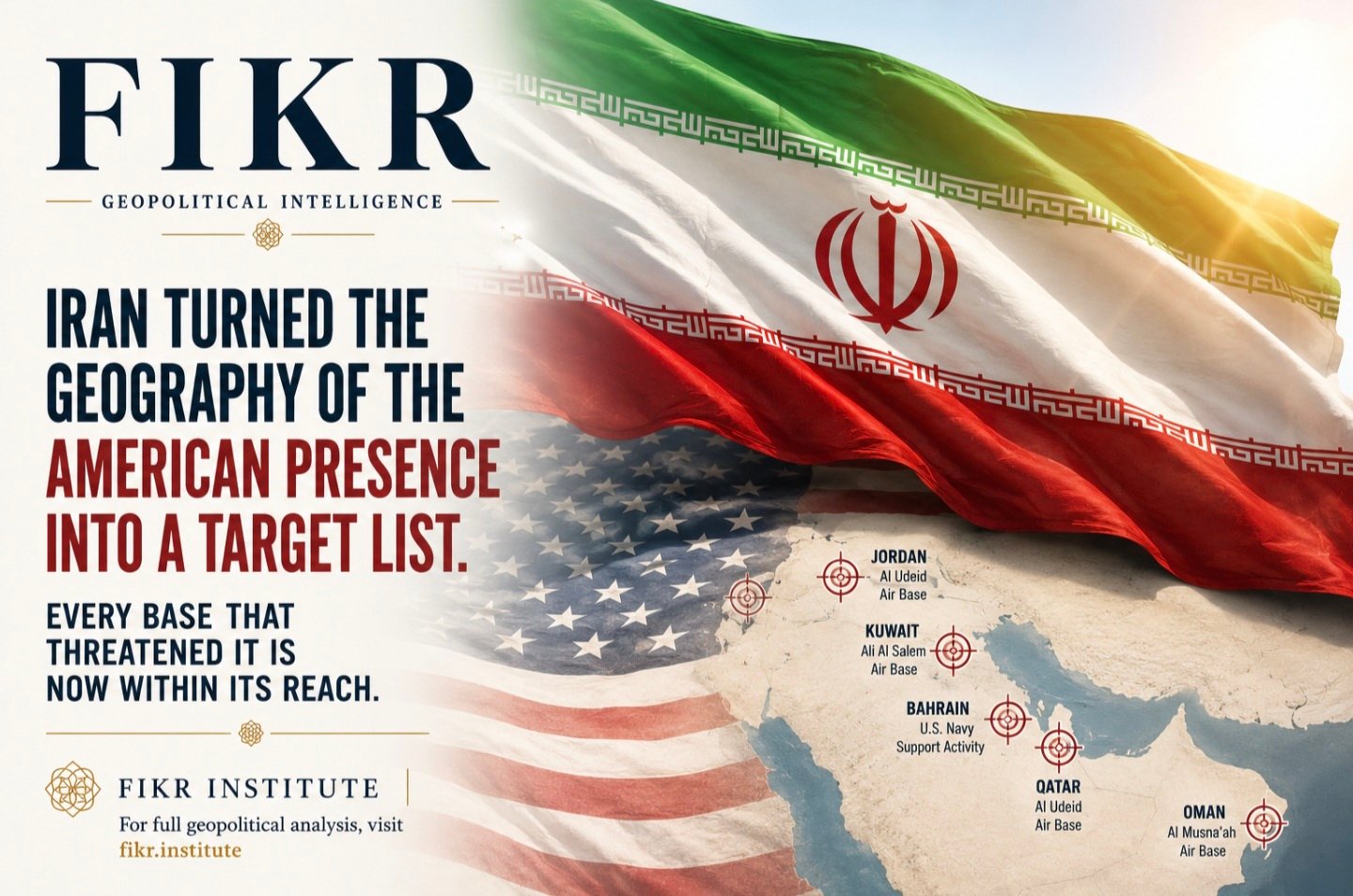
Iran has used exactly this. In response to the American strikes, it launched missiles and drones at American installations across Bahrain, Kuwait, Qatar, Jordan, and Oman, striking the bases from which the campaign against it is partly sustained. [2] It launched a drone attack on the Fifth Fleet in Bahrain. It fired long-range solid-fuel missiles at an airbase in Jordan. It downed an American Apache attack helicopter over the Strait of Hormuz. [3] This is the wrestling principle made military. Iran cannot project power to the American homeland. It does not need to. The United States has brought its power to the doorstep of Iran and stationed it on the territory of the neighbors of Iran, and in doing so has placed it exactly where Iran can reach it. The forward presence that was the American instrument of dominance became, the moment the war began, the exposed American flank. Iran uses the reach of the United States against the United States.
This has an implication that extends well beyond the current exchange, and it is the second strategic point.
The network of American bases in the Gulf is not only a platform for striking Iran. It is the forward shield of the entire regional order the United States underwrites, including the security of Israel. Those bases provide the air defense coordination, the early warning, the interception capacity, and the forward presence that protect the American position across the region. Every one of those installations that Iran demonstrates it can strike, degrade, or force into a defensive posture is an installation less able to perform its wider function. A regional power that establishes it can reach and damage the forward American bases has, in the same act, established that the shield those bases represent is not impermeable. The degradation of the forward platforms is not only a matter of the Iran war. It is a demonstration, watched across the region, that the architecture assumed to guarantee the security of the American order can be contested, and that the interception and defense it provides can be saturated and stretched. What can be reached once can be reached again.
The third point is the behavior of the American side, and here the war has revealed something about the party that is supposedly winning.
A power that is achieving its objective does not need to escalate. It continues doing what is working until the objective is reached. Escalation, the expansion of the target set to new and more extreme categories, is the behavior of a power whose existing methods have not produced the result it demanded. Over the seven nights, the American target set migrated from military and naval sites to bridges, to the electrical grid, and finally to the desalination plant at Jask, whose destruction cut water to 20 villages and 10,000 people. [1] As established in the prior Fikr analysis of this pattern, the turn toward civilian infrastructure is the doctrine of coercion by punishment, and it is the doctrine a military reaches for when the defeat of the forces of the enemy has not delivered surrender. The escalation toward the water supply of civilians is not evidence that the United States is winning. It is evidence that it is not, and that it has chosen to raise the suffering rather than accept that the objective is unreachable at an acceptable cost.
President Trump, offered the option of accepting the situation, has instead publicly rejected the Iranian closure of the strait, threatened to take Kharg Island, reimposed the blockade, and signaled further escalation. [4] This is the disposition that the entire course of the war should call into question. Every escalation since February has produced not Iranian capitulation but wider Iranian retaliation, more Gulf states drawn into the firing line, higher oil prices, and a strait that closes further rather than opening. The pattern is consistent and it has held for five months: each increase in American pressure has been met with an increase in Iranian cost imposition, and the net result of every escalation has been a situation worse than the one that preceded it. A party that responds to the failure of pressure with more pressure, in the face of five months of evidence that pressure produces the opposite of its intent, is not executing a strategy. It is repeating a reflex.
None of this means Iran is winning in any final sense, and the honest assessment must hold the cost in view. Iran has absorbed the death of its Supreme Leader, more than a thousand dead early in the war, at least 50 killed in July alone, the destruction of naval bases and infrastructure, a naval blockade, and the sustained bombing of its coast and its civilian systems. Its population is being made to suffer through the deliberate targeting of the water and power it depends on. To hold an upper hand in the imposition of cost is not to be spared cost. It is a war, and Iran is bleeding in it.
But the question that was asked at the start of this campaign was whether the United States could compel Iran to yield by force. Seven nights into the most concentrated phase yet, the answer on the documented record is that it has not. The strait is closed. The bases are under fire. The Apache is down. The Gulf hosts are in the firing line. The oil price is up. And the American response to all of this is to strike the water supply of villages, which is the thing a power does when the thing it actually wants has been placed beyond its reach by an adversary that understood, better than the superpower did, how to turn the presence of the superpower against itself.
The larger fighter is stronger. He has not been able to end the match. And every time he lunges, the smaller fighter uses the lunge. That is where this war stands tonight, and the side that keeps escalating is the side that cannot make the other yield.
References:
1. Al Jazeera. "Iran Suggests MoU Suspended as 50 Killed in US Strikes in July." July 18, 2026. Also Al Jazeera, "A Seventh Night of US Strikes Cuts Water to Villages in Iran's South," July 18, 2026, on the closed strait, the desalination destruction, and the disabled vessels.
2. Al Jazeera. "Iran Attacks Five Gulf Nations, Shuts Hormuz After US Bombing." July 12, 2026. Citing the Iranian strikes on Bahrain, Kuwait, Jordan, Qatar and Oman.
3. Al Jazeera. "Iran Shuts Hormuz Strait." June 11, 2026. Citing the drone attack on the Fifth Fleet in Bahrain, the long-range missiles at the airbase in Jordan, and the downing of the American Apache over the strait.
4. NPR. "The US Strikes Iran After Trump Announces a Renewed Blockade and Tolls in Hormuz." July 13, 2026. Citing the Trump rejection of the closure on Meet the Press and the renewed blockade. Also NPR, "US Strikes Bridges in Iran; Tehran Targets US Bases in the Gulf," July 17, 2026.