
Abstract:
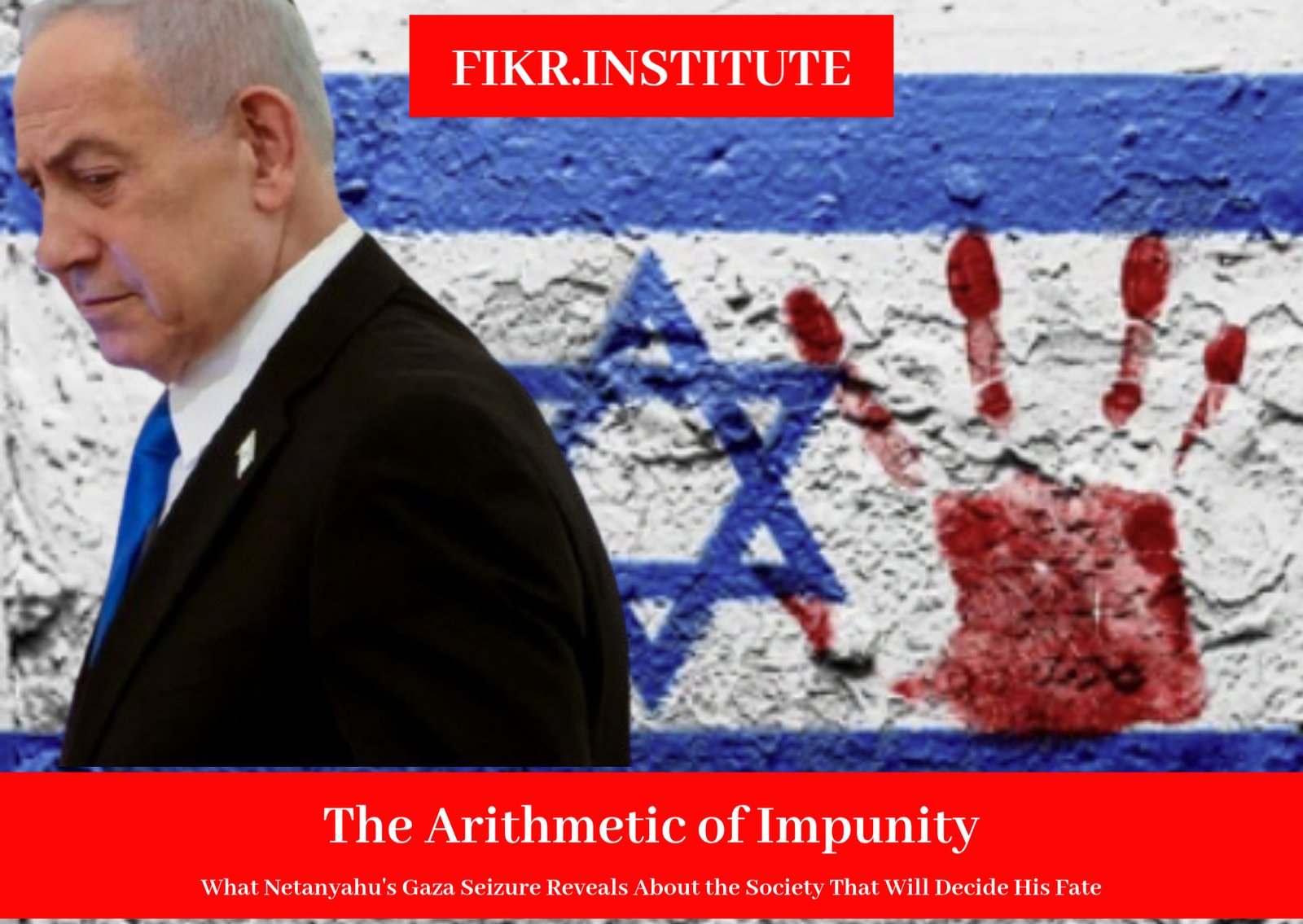
On 28 May 2026, Israeli Prime Minister Benjamin Netanyahu announced the seizure of 70 percent of Gaza, in open defiance of a ceasefire agreement his own government had signed seven months earlier. He faces a general election on 27 October 2026. He faces criminal charges of bribery, fraud, and breach of trust carrying a potential ten-year sentence. The International Criminal Court has issued and upheld arrest warrants against him for war crimes and crimes against humanity. The United Nations has placed Israeli armed forces on its blacklist for conflict-related sexual violence. A Harvard-linked study estimates that 377,000 Palestinians are unaccounted for, a figure that the documented death toll of over 75,000 does not begin to capture. This article argues that the Gaza seizure announcement cannot be understood in isolation from the electoral and legal calendar that produced it, and that the more consequential question it raises is structural: what does it reveal about a political system in which the demonstrated path to electoral viability runs through the maximisation of military violence? The answer implicates not only one leader but the political culture that continues to produce and reward him.
Main Article:
When a state conducts a war and an election simultaneously, the two processes do not remain separate. They feed each other. The logic of electoral survival begins to shape the logic of military command, and what is presented as strategic necessity is often, on closer examination, the arithmetic of political self-preservation.
On 28 May 2026, Benjamin Netanyahu announced at a settler conference in the occupied West Bank that he had directed Israeli forces to seize 70 percent of the Gaza Strip. (1) He was not announcing a new military objective. He was announcing a new number, escalating from 50 to 60 to 70 as if reading from an incremental ledger, with an audience shouting for 100 percent and the prime minister declining to dispute their ambition, saying only that they would proceed in order. (1) The October 2025 ceasefire agreement, brokered by the United States, had placed Israeli forces at a line demarcating approximately 53 percent of Gaza. By mid-March 2026, Israeli forces had already expanded to approximately 64 percent without public announcement, having quietly distributed revised maps to aid organisations. (2) The 28 May declaration brought what had been a creeping territorial seizure into the domain of public political performance.
The timing was not incidental.
Israel holds a general election on 27 October 2026. (3) Netanyahu faces three criminal charges before a three-judge panel at the district court in the occupied city: bribery, fraud, and breach of trust, carrying a potential sentence of up to ten years. (4) He has formally requested a presidential pardon from President Isaac Herzog. (4) His trial resumed in April 2026 after a pause attributed to the conflict with Iran, and he returned to the stand in late April to continue testimony that had been interrupted for months. (5) The International Criminal Court issued arrest warrants against him and former Defence Minister Yoav Gallant on 21 November 2024, for war crimes including the use of starvation as a method of warfare and the intentional targeting of civilians. (6) The appeals chamber upheld those warrants in December 2025. (6) In May 2026, the United Nations Secretary-General added Israeli armed and security forces to the annual report on conflict-related sexual violence, citing verified incidents of sexual violence against Palestinian detainees in 2023, 2024, and 2025, including cases involving men, women, and children from Gaza and the West Bank. (7) Israel cut diplomatic ties with the UN Secretary-General in response. (7)
Each of these facts is individually significant. Read together, they describe a political leader for whom the continuation of military escalation is not a burden but a resource.
An Israeli leader who ended the war, returned to a functioning peacetime government, and appeared in a courtroom as a criminal defendant facing a verdict would be a weakened figure. An Israeli leader who could present himself as the architect of a territorial expansion, the vanquisher of Iran in a June 2025 air campaign conducted alongside the United States, and the commander of a military in active seizure of enemy territory is a wartime leader, and wartime leaders in Israel have historically been able to claim that courts and opposition politicians are undermining national security by pursuing their cases. The judicial overhaul that the Netanyahu coalition launched upon returning to power in late 2022, an attempt to strip the Supreme Court of its ability to block government decisions and give politicians direct control over judicial appointments, was the institutional expression of this logic. It failed, but its attempt was itself a signal about what Netanyahu understood his political situation required. (8)
The question this trajectory forces is the one that Israeli political discourse largely avoids: what does a political system reveal about itself when the demonstrated path to electoral viability runs through the maximisation of military violence?
The Israeli protest movement provides a partial but insufficient answer. In 2023, hundreds of thousands of Israelis demonstrated weekly against the judicial overhaul, the largest sustained protest movement in the history of the country. (8) After 7 October 2023, those protests largely collapsed. Some demonstrators returned, calling for elections and the release of hostages, but their numbers had fallen from hundreds of thousands to thousands. (9) A February 2026 Times of Israel survey found that the anti-Netanyahu bloc, excluding Arab parties, remained short of an outright majority. (10) An April 2026 Haaretz and Channel 12 poll found the coalition projected to fall to 51 Knesset seats, with the opposition reaching 69 seats only when Arab parties were included, a coalition that Israeli electoral arithmetic has historically made difficult to form and sustain. (11) The protest movement was real. Its political translation has been incomplete.
The polling data on substantive questions about Gaza makes the structural problem more visible. A Foreign Affairs analysis published in August 2025, drawing on surveys by the Israel Democracy Institute and Agam Labs, found that more than three quarters of Israelis supported releasing all remaining hostages in exchange for a full end to the war. (12) Yet the same analysis noted that even the harshest proposals for Gaza had drawn significant public support, and that Israeli public opinion had broadly accepted the logic of a permanent security presence in Palestinian territory. (12) The Chatham House assessment of April 2026 described Netanyahu as promoting a vision it called the Super-Sparta model, a state of permanent low-intensity warfare, and noted that while Israelis increasingly resented the absence of a defined end-state, their polling support for the objectives of the campaign remained broadly intact. (11)
This is the tension at the centre of Israeli political culture in 2026: a population that wants the war to end and simultaneously continues to reward the political figure most committed to its continuation, because the alternatives have not found a language for security that does not require ongoing domination of Palestinian territory.
The cost of that political dynamic has been paid overwhelmingly by others.
The Gaza Health Ministry documented 72,049 Palestinian deaths as of February 2026. (13) A peer-reviewed Lancet survey published in February 2026, drawing on field data collected from 2,000 households across Gaza at the end of 2024, estimated 75,200 violent deaths during the first fifteen months of the war alone, with the study period ending before the resumption of full-scale operations in early 2025. (14) The Lancet noted that conditions had deteriorated significantly since the survey period, with famine declared in northern Gaza in August 2025 and health infrastructure comprehensively destroyed. (14) A Harvard-linked study by Ben-Gurion University researcher Yaakov Garb, examining population data and forced displacement patterns, estimated that 377,000 Palestinians are unaccounted for since the war began, representing approximately 17 percent of the pre-war population of 2.23 million. (15) These are not competing numbers. They are different instruments measuring different dimensions of the same catastrophe: the documented floor, the survey-based estimate, and the demographic void that no instrument has yet fully measured.
Against this scale of documented harm, the political mechanism that produced the 28 May announcement becomes legible in a way it is not if examined only as military strategy.
The death in January 2026 of Judge Benny Sagi, president of the Beersheba District Court, added a further dimension to the political atmosphere surrounding the trial. Sagi was connected to the Submarine Affair, a related case within the broader legal complex touching Netanyahu, and was presiding over a case involving media consultant Tzachi Lieber, linked to those proceedings. (16) He died on 1 January 2026 when an off-road vehicle veered onto Route 6 and struck his motorcycle. Israeli police concluded that the driver bore responsibility for the crash due to reckless driving and confirmed drug use. (16) Police found no initial indicators of foul play, and Israeli media described the incident primarily as a road safety tragedy. (16) What cannot be dismissed is the political context in which it occurred: a senior judicial figure connected to a case Netanyahu had worked systematically to prevent from reaching a verdict, dead at a moment when verdicts were approaching. Israeli commentators across the political spectrum noted the timing. The official record says accident. The political environment ensures the question will not be easily closed.
The structure that enables all of this is not unique to one leader. It is the product of a political system in which security discourse has for decades functioned as the master frame within which all other questions are subordinated. A leader who escalates military operations during an election cycle is not behaving irrationally within that frame. He is behaving with precise rationality. The irrationality is structural: a democratic system in which the most extreme military posture is also the most electorally viable posture cannot correct itself through elections, because the elections are the mechanism through which that posture is reproduced.
The opposition coalition forming around the Bennett and Lapid alliance, whose combined polling briefly edged ahead of Likud in some surveys in April 2026, does not dispute the underlying security framework. (11) It disputes Netanyahu personally. The argument it offers Israeli voters is that a different leader would pursue the same security objectives more competently and with less personal corruption. That argument has force. It does not address the structural question of what kind of political culture produces, sustains, and now for the third decade continues to return a leader whose political survival depends on the perpetuation of a conflict whose documented costs to Palestinian life are now measured in the hundreds of thousands.
The announcement of 28 May was addressed to an audience in a West Bank settlement. They cheered for the full hundred percent. He told them they would go in order. First seventy. The election is in October.
The question is not what Netanyahu is doing. Every data point in the documented record explains what he is doing and why. The question is what a political system reveals about itself when this is what winning looks like.
References:
(1) Al Jazeera. "Israel: Netanyahu Directs Army to Seize 70 Percent of Gaza Strip." Al Jazeera, May 28, 2026.
(2) CNN. "Netanyahu Says He Directed Israeli Military to Take Over 70 Percent of Gaza." CNN, May 28, 2026.
(3) Middle East Eye. "Netanyahu Corruption Trials: What Are the Charges and Will He Be Pardoned?" Middle East Eye, December 2, 2025.
(4) Middle East Eye. "Netanyahu Corruption Trials: What Are the Charges and Will He Be Pardoned?" Middle East Eye, December 2, 2025.
(5) The Times of Israel. "Netanyahu Returns to Court to Testify in Corruption Trial After Months-Long Break Due to Iran War." Times of Israel, April 28, 2026.
(6) International Criminal Court. "Situation in the State of Palestine: ICC Pre-Trial Chamber I Issues Warrants of Arrest for Benjamin Netanyahu and Yoav Gallant." ICC, November 21, 2024. Upheld on appeal: Times of Israel, December 16, 2025.
(7) PBS NewsHour. "Israeli and Russian Forces Added to UN Blacklist for Sexual Violence in Conflict Zones." PBS, May 30, 2026.
(8) Britannica. "2026 Israeli Elections." Encyclopaedia Britannica, April 27, 2026.
(9) Al Jazeera. "Netanyahu Dismisses Election Calls as Thousands Protest in Tel Aviv." Al Jazeera, February 18, 2024.
(10) The Times of Israel. "ToI Poll: Most Israelis Do Not Believe PM's Account of His Gaza Policies Before Oct. 7." Times of Israel, February 13, 2026.
(11) Chatham House. "Israel's Perpetual Mobilization: The Limits of Netanyahu's Super-Sparta Model." Chatham House, April 22, 2026.
(12) Foreign Affairs. "Israel's Emerging Occupation Consensus." Foreign Affairs, August 15, 2025.
(13) WAFA Palestinian News Agency. "Gaza Death Toll Surges to 72,049." WAFA, February 12, 2026.
(14) The Lancet Global Health. "From Enumeration to Inference: What the Gaza Mortality Survey Reveals." Lancet Global Health, February 18, 2026.
(15) Housing and Land Rights Network. "Harvard Study Finds Israel Disappeared Nearly 400,000 Palestinians in Gaza." HLRN, citing Yaakov Garb, Ben-Gurion University, June 24, 2025.
(16) Sunday Guardian Live. "Fact Check: Was Judge Benny Sagi Overseeing Benjamin Netanyahu's Corruption Trial Before His Death?" Sunday Guardian Live, January 8, 2026.