
Abstract:
Two days after Pakistan declared open war on Afghanistan, mosque imams in Afghan border provinces declared jihad against the Pakistani army. The Taliban itself has not yet issued a formal state-level declaration, but its armed forces have killed more than 150 Pakistani soldiers and destroyed 40 border outposts, and its spokesmen have warned that retaliation will continue for as long as Pakistani strikes continue. The political momentum toward a full jihad declaration is building, and its consequences, should it arrive, would extend far beyond the battlefield. Every Pakistani Muslim who holds sympathy for the Taliban as a legitimate Islamic governance project and who watched Pakistan bomb a hospital killing 400 civilians now faces a personal reckoning about which side he stands on. The TTP does not need to recruit. Pakistan's army is doing the recruiting for it. This article examines what the conflict costs the Muslim world across every possible outcome: Pakistani military victory, Taliban jihad declaration, and Chinese-mediated settlement. It argues that none of these outcomes can produce genuine Muslim welfare, because the nation-state architecture that generates the conflict was designed not to serve the peoples it governs but to perpetuate the fragmentation of Muslim political power that the colonial order requires.
Main Article:
A principle that runs through the history of colonial state-building is worth stating plainly before examining any specific conflict it produces: a political structure designed to fragment a people cannot be used by that people to unify themselves. The instrument reflects the intention of its maker.
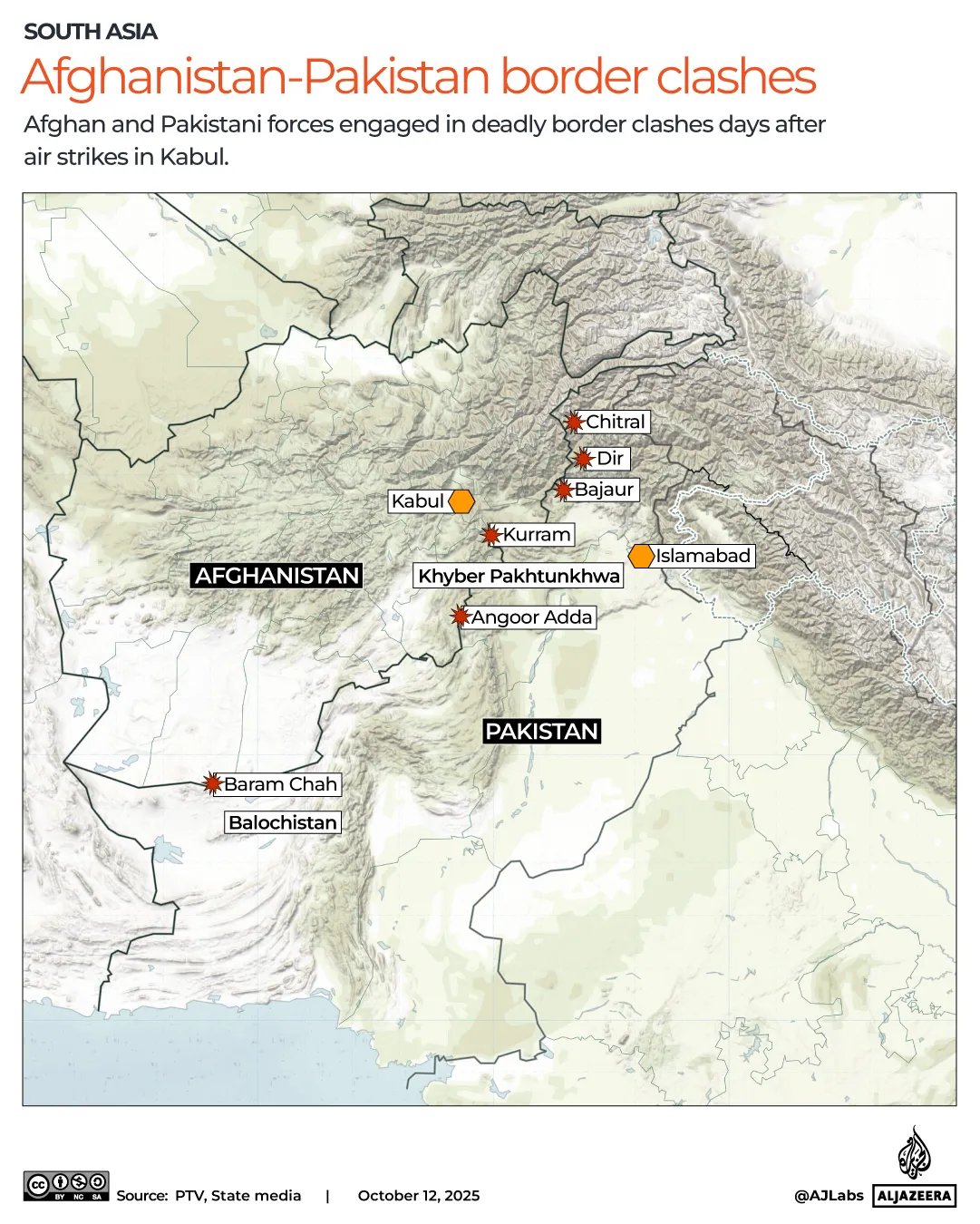
On February 28, 2026, one day after Pakistan declared open war on Afghanistan and struck Kabul, Kandahar, and provinces across the Afghan interior, mosque imams in Afghan border provinces declared jihad against the Pakistani army. The Taliban's armed forces, operating under what the Afghan Ministry of Defense described as large-scale offensive operations, had by that point killed more than 150 Pakistani soldiers, destroyed 40 border outposts, and captured territory along the Durand Line. Taliban spokesmen warned that retaliation would continue for as long as Pakistani strikes continued. The formal state-level jihad declaration had not yet been issued. The conditions producing it were fully assembled.(1)
The significance of the mosque declarations is not ceremonial. It is structural. The Taliban governs through a framework in which religious authority and political authority are unified. When mosque imams in provinces bordering Pakistan declare jihad against Pakistan's army, they are not issuing a protest statement. They are issuing a mobilization call that operates through the same networks of religious education, tribal loyalty, and ideological commitment that sustained a twenty-year insurgency against the world's most powerful military alliance. The TTP, whose stated objective includes overthrowing the Pakistani state, does not need to recruit from this mobilization. It needs only to exist as the organizational structure into which that mobilization flows.
Pakistan's army has created, through its hospital strike alone, a cohort of grievance that no counterterrorism operation can address.
Every Pakistani Muslim who had regarded the Taliban with sympathy as a movement that expelled foreign occupation and established Islamic governance, and who watched Pakistan drop bombs on a facility holding 3,000 recovering drug addicts, now faces a question about institutional loyalty that no amount of official narrative management resolves. The Pakistani military establishment's response, which has been to describe the patients as suicide bombers, has not convinced international observers, confirmed UN investigators, or the Afghan border communities who share ethnic, linguistic, and kinship ties with the people being killed. It will not convince the Pakistani Muslim who applies the same standards of evidence he would apply to any other claim.(2)
The trajectory toward a formal Taliban jihad declaration against Pakistan produces consequences that extend far beyond the immediate battlefield. Pakistan's own territory includes approximately 30 to 40 million Pashtuns in Khyber Pakhtunkhwa and Balochistan, who share ethnic identity, family connections, and in many cases ideological sympathy with the Taliban movement across the Durand Line. A formal jihad declaration does not create new enemies for Pakistan inside its own borders. It activates existing ones. The TTP's sustained insurgency has already demonstrated that it can maintain operational tempo against Pakistani security forces across multiple provinces simultaneously. A formal jihad declaration by the Afghan Taliban would provide that insurgency with the one resource it currently lacks: religious and political legitimacy derived from a recognized Islamic governance authority.
Pakistan's military establishment has not conducted this calculation publicly because conducting it publicly would reveal the scale of the strategic error it has committed. The army that created the Taliban to project power into Afghanistan has produced a war that is projecting Afghan power into Pakistan. The structure of blowback is now reversed: the client is threatening to consume its creator.(3)
Three outcomes are analytically possible. None of them is good for the Muslim world.
The first is Pakistani military victory, defined as the destruction of sufficient Taliban military capacity to compel political compliance on the TTP question. This outcome requires a sustained air campaign across Afghan territory, ongoing civilian casualties at the scale already documented, and the eventual installation of a Taliban administration so weakened militarily and politically that it governs Kabul on Islamabad's terms rather than its own. What this produces is Afghanistan as a Pakistani client state, its sovereignty hollowed out, its population governed by a movement that already oppresses women, bans girls from education above the sixth grade, and administers justice through a documented record of summary execution, while that movement now also serves as a buffer zone for Pakistani military ambition. The Afghan population would be governed by Taliban ideology in the service of Pakistani strategic requirements. This is not Islamic political achievement. It is Muslim governance being shaped by a foreign military patron under a different name.
The second outcome is full jihad declaration and escalating insurgency. If the Taliban formally declares jihad against the Pakistani army, the political geography of Khyber Pakhtunkhwa and Balochistan transforms overnight. Pakistan faces a two-front conflict: the Afghan state across the Durand Line and the TTP inside its own territory, now reinforced by the moral and political authority of a formal jihad declaration from a recognized Islamic governance entity. Pakistan's army, which is already fighting a sustained domestic insurgency while simultaneously conducting an air campaign in Afghanistan, would be fighting a conflict on both sides of a border that exists legally but not geographically, ethnically, or tribally. The cost to Pakistan's civilian population, which already bears the economic weight of a military establishment consuming a disproportionate share of a fragile budget while the person who won the most votes loses his eyesight in prison, would be catastrophic. The cost to the Afghan civilian population, which has already lost 115,000 displaced persons and hundreds of documented civilian casualties since the war began, would compound further. Two Muslim populations would be destroying each other's material welfare in a war whose origins lie in a colonial boundary drawn in 1893 by a British civil servant named Mortimer Durand, who was serving British imperial interests rather than Pashtun ones.(4)
The third outcome is Chinese-mediated settlement. China is already mediating talks between Pakistan and the Taliban, confirmed by reports of discussions in China in early April 2026. China has $46 billion invested in the China-Pakistan Economic Corridor and requires both Pakistani stability and Afghan territorial integration into its Belt and Road connectivity architecture. A Chinese-mediated settlement serves Chinese commercial interests. It produces a framework in which Pakistan and Afghanistan manage their border under conditions that allow CPEC extension and Afghan mineral integration into Chinese supply chains. The Durand Line remains. The Taliban retains its governance model. Pakistan's military retains its domestic dominance. And the Muslim populations on both sides of the colonial border continue to be governed by institutions whose ultimate accountability runs to Beijing and Washington rather than to the people they nominally govern.(5)
To understand why every available outcome produces the same result requires examining the structure that generates the conflict rather than the actors within it.
The Durand Line is not a border in any meaningful sense. It is a colonial administrative division drawn in 1893 to serve British imperial strategy, specifically to create a buffer zone between Russian Central Asia and the British Indian subcontinent, and to divide the Pashtun homeland in a way that prevented the emergence of an independent Pashtun political entity that might challenge British control of the northwest frontier. When Pakistan was created in 1947 from the partition of British India, it inherited the Durand Line as its western boundary. Afghanistan voted against Pakistan's admission to the United Nations in 1947, the only country to do so, specifically because it refused to recognize the Durand Line as a legitimate international border. That vote was not a diplomatic accident. It was the expression of a political reality that the colonial division had failed to erase: that a people divided by an administrative line drawn for someone else's purposes do not accept that line as the definition of their political identity.
Every war Pakistan and Afghanistan have fought, every border skirmish, every TTP attack, every Pakistani airstrike, every Taliban retaliation, is a consequence of that original division being maintained by states whose existence depends on it remaining in place. Pakistan cannot exist without the Durand Line. Afghanistan cannot achieve territorial coherence with it. The conflict is not between two sovereign nations with genuine national interests in tension. It is the predictable expression of two colonial administrative units fighting over a division neither of them created and neither of them can resolve within the framework that defines them.(6)
This is the structural fact that makes every mediation effort, whether by China, Saudi Arabia, Qatar, or Turkey, insufficient in its design. Every mediation effort accepts the nation-state framework as the given and attempts to make the colonial units function more smoothly within it. None of them asks whether the units themselves are the problem. None of them can ask that question without threatening the legitimacy of every state participating in the mediation.
The most consequential strategic fact about Pakistan that the current crisis illuminates is one that Western analytical discourse almost never addresses directly. Pakistan is the only nuclear-armed Muslim-majority state in the world. It possesses between 160 and 170 nuclear warheads by credible Western estimates. Its military is the most organizationally sophisticated in the Muslim world. Its geographic position connects South Asia, Central Asia, West Asia, and the Chinese interior. Its population of 250 million includes the world's second largest Muslim population. Under any framework for genuine Muslim political consolidation, Pakistan's nuclear capacity, military experience, geographic position, and population represent the most significant material asset available to any Islamic political project seeking genuine independence from the colonial order.
Washington understands this even when it does not say so. A stable, prosperous, genuinely independent Pakistan integrated into a coherent political framework that corresponds to the actual bonds of the peoples it governs would be more threatening to American strategic interests than any conventional military adversary in the region. The current configuration of Pakistani politics, military establishment governing, elected leaders imprisoned, people's votes producing no governing consequences, army simultaneously bombing Afghanistan and collecting Saudi money and mediating American diplomacy, serves American interests precisely because it prevents the mobilization of Pakistan's actual potential. The Afghanistan war accelerates the internal destabilization that keeps Pakistan's enormous political capacity permanently directed away from its own interests.(7)
The Pakistani military does not understand this because it cannot afford to understand it. Comprehending the full logic of the relationship would require the Pakistani military establishment to conclude that it has been the primary instrument of its own population's political subjugation for seventy-five years, that every decade of American money and political protection has cost Pakistan more in genuine sovereignty than it has delivered in security, and that the indispensability it has constructed for itself is indispensable only to the order that requires Pakistan's fragmentation. That is a conclusion no institution can reach about itself while remaining functional.
The cost to the Muslim world of this conflict does not end when the guns stop. It is structural and continuous. Every generation of Pashtuns raised on both sides of the Durand Line who are taught to identify as Pakistani or Afghan rather than as the single people whose unity the colonial order severed is a generation whose political capacity is captured by the colonial administrative framework. Every Pakistani Muslim whose political energies are consumed by the TTP insurgency, the Afghan war, the economic collapse, and the imprisonment of elected leaders has less capacity to imagine and build a political order that serves Muslim interests. Every Afghan Muslim governed by Taliban restrictions on women and education, or by Pakistani military strategic requirements, or by Chinese commercial connectivity conditions, is governed by something that does not correspond to what genuine Islamic political order requires.
The guns that Pakistan is firing into Afghanistan are paid for partly with Saudi money, authorized partly by American strategic validation, and rationalized partly by a counterterrorism justification that the UN has confirmed lacks credible legal basis. The people dying under those guns are Muslims. The people dying from the TTP's response to those guns are Muslims. The people who will die if the jihad declaration comes and the conflict spreads into Pakistan's own interior are Muslims. And the colonial nation-state framework that generates every element of this chain, from the Durand Line to the ISI's proxy cultivation to the TTP's emergence to the hospital strike, is a framework that Muslim political action has not yet succeeded in replacing.
That is the cost. And it compounds with every round of ammunition fired.
References:
(1) Hasht-e Subh, "The Taliban-Pakistan War: Mosque Imams Declare Jihad Against Pakistan as TTP Issues Warning," February 28, 2026; Wikipedia, "2026 Afghanistan-Pakistan War," updated April 2026.
(2) OHCHR, "Afghan-Pakistani Border: UN Experts Urgently Call for Lasting Peace," March 2026; Wikipedia, "2026 Kabul Hospital Airstrike," updated April 2026.
(3) CSIS, "Why Did Pakistan Announce Open War Against the Taliban?" February 27, 2026.
(4) Wikipedia, "2026 Afghanistan-Pakistan War," updated April 2026, confirming 115,000 displaced and documented civilian casualties; Lowy Institute, "The Other War the World Is Ignoring," March 13, 2026.
(5) Wikipedia, "2026 Afghanistan-Pakistan War," updated April 2026, confirming China-mediated talks in April 2026; Lowy Institute, "The Other War the World Is Ignoring," March 13, 2026.
(6) Wikipedia, "Afghanistan-Pakistan Border Skirmishes," updated April 2026, confirming Afghanistan voted against Pakistan's UN admission in 1947; Al Jazeera, "Pakistan Bombs Kabul: Why Are Afghanistan and Pakistan Fighting?" February 27, 2026.
(7) Times of Islamabad citing Express Tribune, "Dramatic Shift in US South Asia Policy Elevates Pakistan Over India in 2025," December 22, 2025; Zohaib Ahmed, "Pakistan-USA Relationship 2025: Strategic Foresight Analysis," November 14, 2025.