
Abstract:
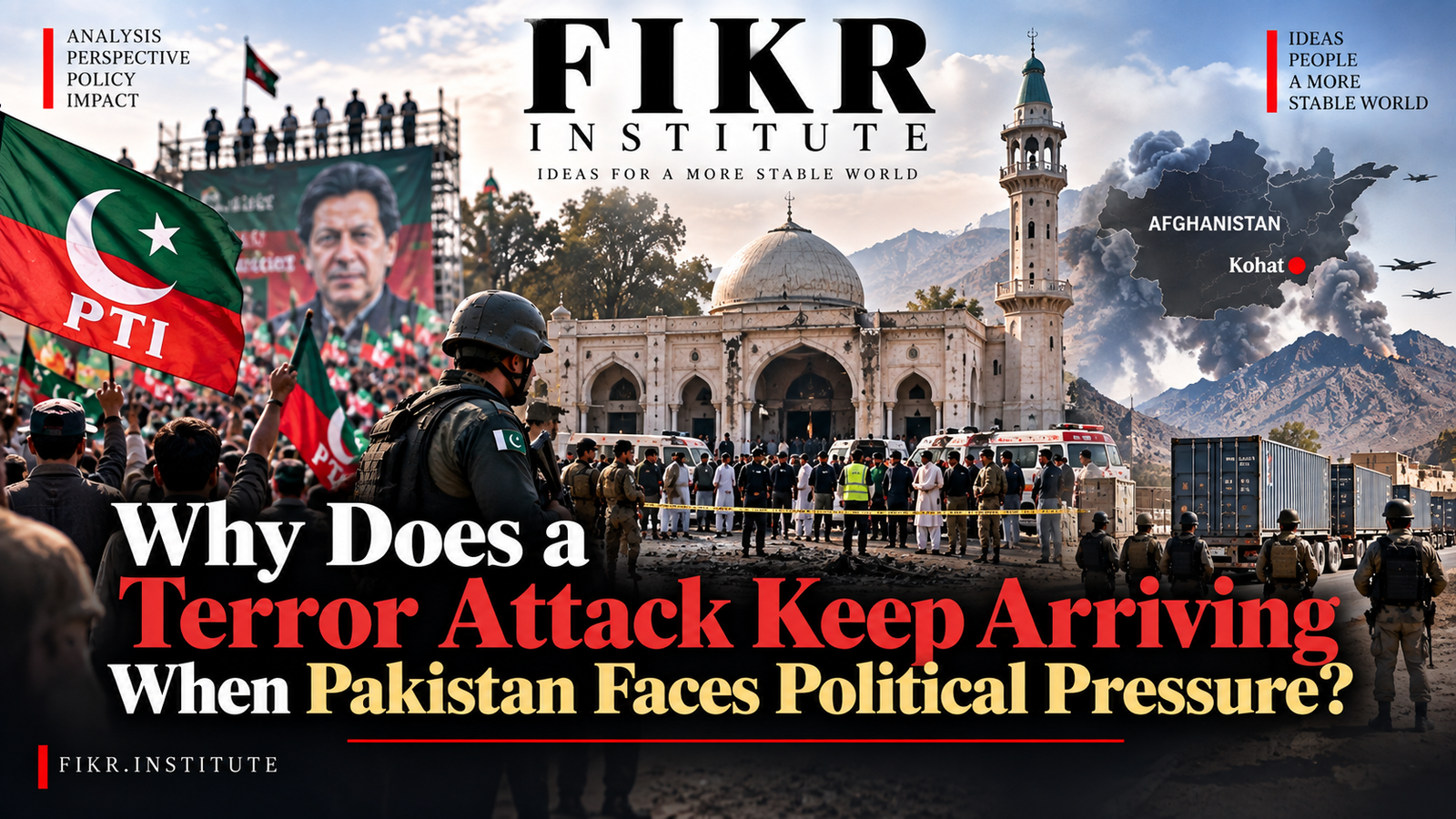
When a government faces its own citizens, the timing of its emergencies deserves as much scrutiny as the emergencies themselves. In September 2026 the party of jailed former prime minister Imran Khan called a march on Islamabad for September 27. On September 18 attackers struck a mosque inside the Kohat police headquarters, killing at least 21 people according to the Associated Press and at least 31 according to Al Jazeera. A militant alliance claimed it. Within a day, security sources named one bomber as an Afghan national without disclosing how. The three sisters of Imran Khan were detained, more than 2,000 containers sealed Islamabad, the interior minister cited the dead while warning that PTI was preparing to storm a city, and Pakistani jets struck Afghanistan twice. In November 2025 and February 2026 attacks were likewise followed by Afghan attributions without public evidence, at moments of political consequence at home. Pakistan suffers hundreds of attacks a year, so timing alone proves nothing, and Fikr does not claim the attacks were staged. The questions are what the evidence is, how each attack was used, and why the answer keeps landing in Afghanistan.
Main Article:
When a government faces its own citizens, the timing of its emergencies deserves as much scrutiny as the emergencies themselves. An attack is a fact. Attribution is a claim that requires evidence. What a state does with the attribution is a choice, and the choice reveals the interest behind it.
The limit of the evidence must be stated first. Pakistan recorded 699 terrorist attacks and at least 1,034 deaths in 2025, according to the Pak Institute for Peace Studies, a 34 percent rise in attacks over the previous year [1]. In a country bleeding at that rate, an attack near a political event proves nothing by itself. Chronology is a reason to ask questions. It is not an answer.
In September 2026 the Pakistan Tehreek e Insaf, the party of jailed former prime minister Imran Khan, announced a march on Islamabad for September 27 to demand his release [2]. What followed ran in this order.
On September 18, during Friday prayers, a vehicle packed with explosives struck the entrance of a mosque inside the police headquarters in Kohat, and gunmen stormed the compound. The Associated Press reported a 20 hour gun battle that killed at least 21 people, most of them police officers [3]. Al Jazeera reported at least 31 dead, including 16 police personnel [4]. Ittehad ul Mujahideen Pakistan, an alliance formed in April 2025 that includes the Hafiz Gul Bahadur group, claimed the attack through supporters on Telegram [4][5].
By September 19, security sources had named one of the bombers as Matiullah, an Afghan national, while the second attacker was still unidentified [6][7]. Neither report said how he was identified. No passport, fingerprint record or DNA match was described [6][7]. That does not mean no such evidence exists. It means none has been shown.
On September 19 police detained Aleema Khan, sister of Imran Khan, at her home in Lahore. On September 20 they took her sisters Uzma Khan and Noreen Niazi from their homes in armoured vehicles to unknown locations, all under 30 day preventive detention orders issued under the Maintenance of Public Order law [2]. All three are over 65 [8]. Interior Minister Mohsin Naqvi warned the party that "there is still time" and told it not to enter a situation from which there would be no turning back [2].
That night Pakistani jets struck eastern Afghanistan. Islamabad said it hit a suicide bombing centre and an arms depot and killed 28 fighters. The Taliban said three civilians were killed [5], and the United Nations confirmed civilian casualties [3].
By September 24 more than 2,000 containers had been welded together and filled with sand and gravel across Islamabad and at Attock Bridge, motorways from Khyber Pakhtunkhwa were sealed, and PTI said more than 1,500 of its workers had been detained along with lawmakers [8]. Naqvi then made the connection himself. "There was a suicide attack on a mosque, and two or three other attacks," he said in Lahore. "Our captain was killed, our soldiers were killed, our policemen were killed, and these people are preparing to storm a city" [8].
That sentence requires no theory about who organized the Kohat attack. It is on the record. The dead of Kohat had become an argument against a political march in Islamabad.
On September 24 Pakistan struck ten sites in Afghanistan that it said were used to launch drone attacks against Pakistan, a claim Taliban spokesman Zabihullah Mujahid rejected. Afghan authorities reported four civilians killed [3]. On September 25 PTI postponed its march to October 4 without giving a public reason [9].
The sequence is documented. Its meaning is not.
Fikr does not claim the Kohat attack was staged, and no evidence establishes that. What the record establishes is the use the state made of the attack within 72 hours: an identification pointing across the border whose basis was not shown, strikes on Afghan soil, and the dead invoked to justify sealing the capital against a political march.
This is not the first time the calendar has aligned this way.
On November 11, 2025, a suicide bomber killed 12 people outside a court in Islamabad. On November 13, Naqvi told parliament that the bombers in that attack and another in South Waziristan were Afghan nationals. Al Jazeera reported no specific evidence behind the claim. The same day, parliament passed the 27th constitutional amendment, which granted army chief Asim Munir lifetime immunity and consolidated military power [10].
On February 6, 2026, a suicide bomber killed at least 31 worshippers at a Shia mosque in Islamabad. The ISIL group claimed it, and Defence Minister Khawaja Asif alleged the attacker had been travelling to and from Afghanistan [11]. Two days later PTI held a nationwide shutter down strike on the anniversary of the disputed 2024 elections [12]. On February 22 Pakistani strikes hit Nangarhar and Paktika, citing attacks in Islamabad, Bajaur and Bannu. The targets included a religious school and homes, and at least 17 people were confirmed killed [13]. By February 27 Pakistan had declared open war [14]. On March 16 a strike on a drug rehabilitation centre in Kabul killed at least 269 people and wounded 122, according to the final count of the UN mission in Afghanistan [15].
Three moments. Three claimed attacks. Three Afghan links asserted by officials before any evidence was shown. And three moments of political consequence at home: an amendment expanding military power, a nationwide opposition strike, and a march on the capital.
Three moments do not make a law. Pakistan suffers too many attacks for that. But three moments are enough to justify three questions.
The first is evidence. When officials name a dead suicide bomber as a foreign national within a day, the public is entitled to know what established it: a document, a fingerprint, a DNA match, a phone record. In Kohat, none has been described. In Islamabad in November 2025, none was reported. When nationality becomes part of the case for bombing another country, an identification that cannot be inspected remains an assertion.
The second is use. The question is not whether political pressure caused the attacks. No evidence establishes that. The question is what was done with each attack once it happened. In September the interior minister answered it himself, tying the deaths of soldiers and police to the march he was blocking.
The third is direction. The Taliban insist that "Pakistan should not attribute its internal situation to Afghanistan" [5], and Islamabad insists the attackers come from Afghan sanctuaries. Both are interested parties, and neither has placed its evidence in public view. Yet the Kohat attack happened inside a police compound in Pakistan. How did a vehicle packed with explosives and eight gunmen reach a mosque inside police headquarters? That question begins in Kohat before it reaches Kabul.
An attack is a fact. Attribution is a claim. What a state does with it is a choice. Until Islamabad shows its evidence, the calendar remains the most consistent witness in the case.
References:
1. Pak Institute for Peace Studies. "Pakistan Witnessed 34 Per Cent Increase in Terrorism in 2025: PIPS Annual Security Report." 2026.
2. Al Jazeera. "Former Pakistan PM Imran Khan Sisters Arrested Before Planned PTI March." September 20, 2026.
3. Associated Press, as carried by CP24. "Pakistani Airstrikes Target Afghanistan After Islamabad Accuses Kabul of Drone Attacks." September 24, 2026.
4. Al Jazeera. "Bomb Attack at Pakistan Mosque Kills at Least 31 People." September 18, 2026.
5. FDD Long War Journal. "Pakistan Conducts Airstrikes in Eastern Afghanistan in Retaliation for Terrorist Attacks." September 21, 2026.
6. Aaj English TV. "Kohat Police Lines Bomber Identified as Afghan National." September 19, 2026.
7. The Nation. "Afghan National Identified Among Suicide Bombers in Kohat Attack." September 20, 2026.
8. Al Jazeera. "Source of Anxiety: Pakistan Cracks Down Before March to Free Imran Khan." September 24, 2026.
9. Aaj English TV. "PTI Postpones Long March to Oct 4, CM Afridi Announces." September 25, 2026.
10. Al Jazeera. "Pakistan Says Islamabad, South Waziristan Bombers Were Afghan Nationals." November 13, 2025.
11. Al Jazeera. "At Least 31 Killed, Dozens Wounded in Suicide Blast at Islamabad Mosque." February 6, 2026.
12. Arab News Pakistan. "Imran Khan Party Calls for Shutter Down Strike on Second Anniversary of Pakistan Elections." February 8, 2026.
13. Al Jazeera. "Afghanistan Promises Appropriate Response After Deadly Pakistani Strikes." February 22, 2026.
14. Council on Foreign Relations. "Conflict Between Afghanistan and Pakistan." Global Conflict Tracker, 2026.
15. Al Jazeera. "Over 370 Afghans Killed in Pakistan Conflict in First 3 Months of 2026: UN." May 12, 2026.