
Abstract:
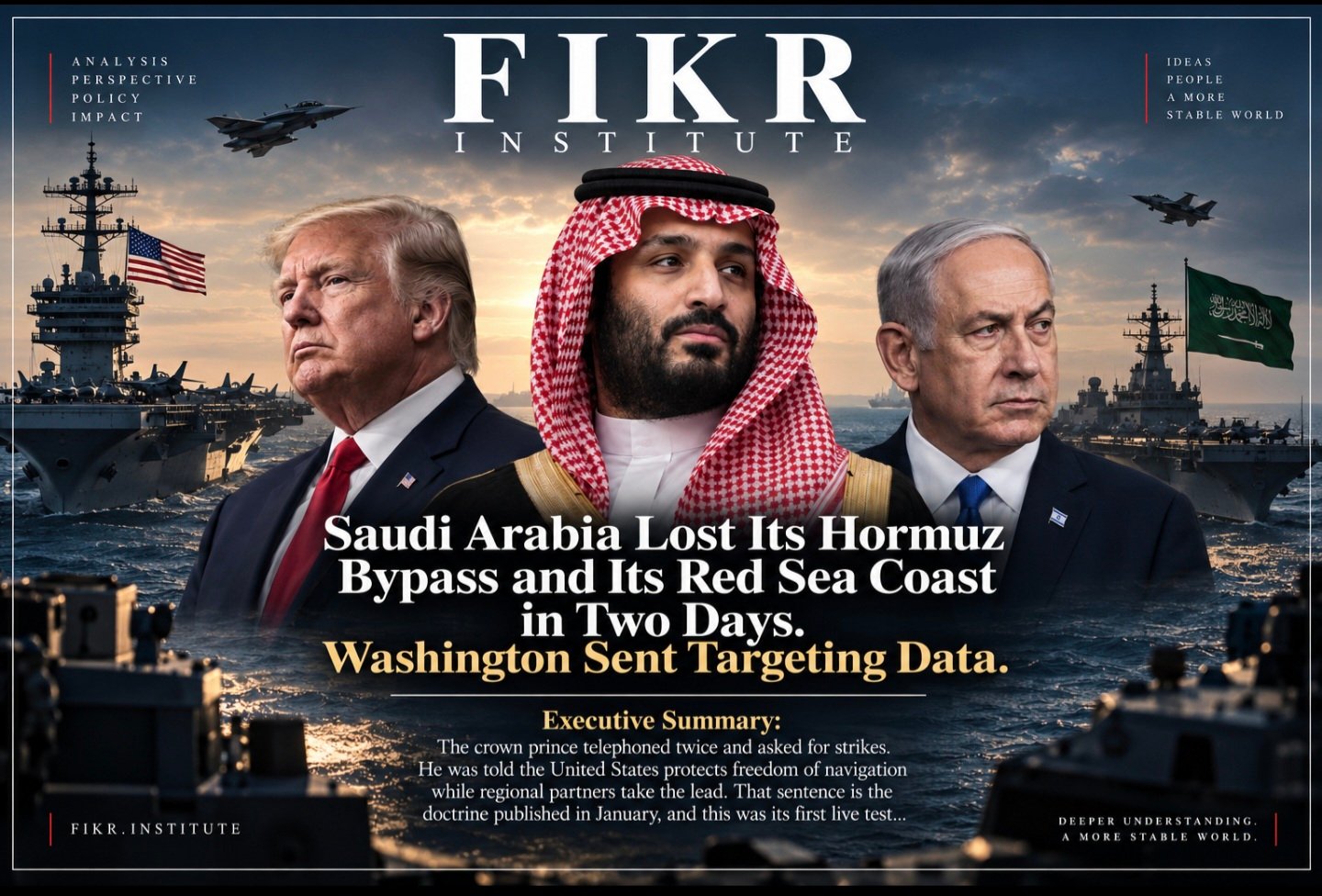
Over two days in September, forces aligned with Iran completed the seizure of the Yemeni Red Sea coastline including Mocha, Dhubab and Perim Island at the narrowest point of the Bab el Mandeb, while drones launched from Iraq struck pumping stations on the Saudi East and West pipeline and forced its shutdown. That pipeline was the overland route by which the kingdom bypassed the blockaded Strait of Hormuz. The Saudi crown prince telephoned the American president at least twice requesting military strikes and was refused, receiving intelligence and targeting support instead. This piece sets out what happened, tests three explanations for the refusal against the record, and states the conclusion of this publication.
Main Article:
A security guarantee is not tested by the signing of it. It is tested on the first day that honouring it would cost the guarantor something, and until that day arrives the arrangement is a subscription nobody has tried to claim on. Both parties may hold entirely different beliefs about what has been promised, and neither will discover the difference, because the discovery requires a bill. When it comes, it comes quickly, and what the client learns in that moment governs everything it does afterwards.
Riyadh received its bill over two days last week.
On Thursday and Friday, forces aligned with Iran completed a rapid advance down the Yemeni Red Sea coast. They took the port city of Mocha, then the mainland town of Dhubab, and then Perim Island in the Bab el Mandeb, after Saudi backed government forces withdrew from it [1][2]. The offensive is reported to have killed hundreds and displaced at least seventy six thousand people [3]. Holding those positions does not give sovereign control of the strait, since the western shore is not Yemeni territory, but it gives a dramatically stronger ability to contest, threaten and potentially deny passage through it [2].
The collapse of the opposing force was the striking feature. Government units withdrew rather than fought, and a Yemeni military source told CNN that the battalions encountered at Mocha stood at roughly a fifth of their paper strength, with rosters padded by names drawing salaries. That claim rests on a single source and is recorded here as such.
On the same days, drones, reportedly launched from Iraq struck pumping stations on the Saudi East and West pipeline in the Riyadh and Medina regions, causing injuries, and the energy ministry confirmed the shutdown [1][4].
Understand what that pipeline is. It runs about seven hundred and forty five miles from the eastern oil fields to the Red Sea terminal at Yanbu, and it exists precisely to move crude without passing through the Strait of Hormuz, through which roughly a fifth of the oil in the world moved before the war began in late February [4]. The strait has been blockaded since. The pipeline was the answer to the blockade. Within two days the answer was shut and the alternative maritime exit was placed under the guns of the people who had just taken the coastline.
The market read it immediately. Saudi crude supply had already fallen by 2.3 million barrels a day in August to about six million, the lowest in more than three decades, according to the International Energy Agency. Rates for the largest crude carriers reached record highs, and Brent closed the week above a hundred dollars for the first time since May [2].
So the crown prince telephoned Washington.
He called the American president at least twice on Thursday, first to brief him on the advance toward Mocha and then to urge American strikes against the Houthis [1][2]. The president declined to conduct them. What was offered instead was intelligence and targeting data, alongside the roughly two hundred American military personnel already in the kingdom [1].
The explanation given was not improvised, and it is the most important sentence of the week.
American officials stated that the objective is ensuring freedom of navigation while expecting regional partners to take the lead in operations, and the White House described itself as protecting core national security interests while empowering regional partners to manage and resolve regional security challenges [5].
Compare that with the National Defense Strategy published in January, which directed that the department would empower regional allies and partners to take primary responsibility for deterring and defending against Iran and its proxies, while the United States concentrated on the homeland, the hemisphere and China. The language in the statement is the language in the doctrine. This was not a refusal of policy. It was the execution of policy, and it was the first occasion on which any client had asked for the guarantee and been handed the document instead.
Eighteen months ago the same president opened a military campaign against the same movement to keep the same strait open. What changed in the interval is not the threat.
Three explanations fit the record and they are not mutually exclusive.
The first is doctrine. Washington wrote in January that its partners must carry the region and it is doing what it wrote. On this reading nothing improper occurred, the policy was published in advance, and Riyadh simply had not believed it.
The second is incapacity. The United States currently maintains roughly fifty thousand personnel and nineteen warships including two aircraft carriers committed to the war with Iran, with deployments extended into 2027, air defence units diverted from planned postings in Europe and the Pacific, and four combatant commanders having recorded formal objections in August that the campaign is eroding the capacity to respond elsewhere. A power that cannot resource a second front does not open one, and the doctrine may be the language in which that limitation is expressed rather than the reason for it.
The third is leverage, and the sequence is documented even though the causal link is not.
In July the American energy department concluded a civil nuclear cooperation agreement with Riyadh, and the president then attached a condition that had not been in the negotiated text, namely Saudi accession to the Abraham Accords. Riyadh did not move from the position it has held since 2023, that a verifiable path to Palestinian statehood must come first. On the seventh of August the kingdom signed a mutual defence agreement in Mecca with Türkiye and Pakistan, which is to say it purchased security elsewhere. Five weeks later it asked Washington for military action and did not receive it.
Those four events are established. What is not established is whether the fourth follows from the first, and no document has been produced connecting them.
There is a fourth matter which is unresolved rather than explained, and it should be recorded as unresolved.
The origin of the pipeline drones is established. Saudi Arabia stated they came from Iraq, Baghdad located the launch site in Maysan province, dismissed the provincial operations commander, closed the Shalamcheh border crossing with Iran and opened a security operation [3][6]. Riyadh held off retaliation at the request of the Iraqi prime minister while reserving its rights [4].
Origin is not authorship. Iran denied involvement, and a senior Iranian official maintained that Iran does not control the Houthis [6]. The Iraqi armed groups named in the reporting also denied responsibility. That is the third occasion this year on which Saudi energy infrastructure has been struck and Iran has formally denied it, in March, in late July and now.
Set against that, Iran has publicly claimed its strikes on the Emirates, Bahrain, Qatar, Kuwait and Jordan, repeatedly and in detail. A state that announces its attacks on five neighbours and denies them on a sixth is either behaving inconsistently or is not the author on the sixth.
Two questions follow and neither has been answered by anybody. The first is motive. Tehran is at this moment seeking Gulf agreement on passage through the Strait of Hormuz, and shutting the principal Saudi export route days beforehand works against the thing it is trying to obtain. The second is the response. Saudi Arabia has conducted a decade of air operations in Yemen and has taken no action whatever against any Iraqi group it has accused, deferring instead to a request from Baghdad. That is a restraint it has shown nowhere else, and it is unexplained.
The limit is this, and it is narrow. Iranian denial establishes nothing on its own, and this publication does not treat a denial as proof. What the record does establish is that the attribution offered has no motive attached to it and has produced no consequence, three times this year, and that an explanation which leaves both of those blank is not an explanation. It is hard to identify no other author, because we do not have the evidence to identify one, but we also note the inconsistency and how it points to an unnamed one. We record that the account on offer is insufficient and that the question is open.
The conclusion of this publication.
What follows is the judgment of Fikr Institute, offered as judgment and not as documentary finding.
We hold that the price of American protection has been named, and that it is the Abraham Accords. Washington attached recognition of Israel to the nuclear file in July and Riyadh refused. Riyadh went to Mecca in August and bought a guarantee from a NATO army and a nuclear armed state instead. In September, with its bypass shut and its coastline gone, it asked for strikes and received targeting data. We do not claim a document connects those events. We say the sequence is the sequence, that every party to it can read a calendar, and that a client which declines the political condition and then discovers the military guarantee has become advisory has been told something whether or not anybody wrote it down.
We hold, second, that this is Kabul in August 2021 repeated with a different flag. An army existed on a payroll and not in the field, its rosters filled with men who were never there, financed for years by patrons who never audited what they were buying, and it dissolved on contact in a single week. The lesson of Kabul was not learned because it was never a lesson. It is the standing condition of forces built by foreign money for foreign purposes, and it will happen again wherever that arrangement exists.
We hold, third, that the pattern of attribution around the attacks on Saudi Arabia is unexplained and that it points somewhere. Iran claims what it does everywhere else and denies this alone, three times. The Iraqi groups deny it. The party that gains most from a Riyadh squeezed until it accepts the Accords is not Tehran, which needs Gulf cooperation for the Hormuz arrangement it is negotiating this week, and is not Washington, which wants oil prices down before an election. We endorse no accusation and we reject none. We record that the question is open, that it has been open three times this year, and that we will publish the answer when it can be established.
And we hold, finally, that the United States may simply be unable. Fifty thousand personnel, nineteen warships and two carriers are committed to one adversary, its own commanders have written that the force cannot sustain it, and its strategy of January now prioritises its own hemisphere. A power in that position does not refuse a second war because it is calculating. It refuses because it has nothing left to send.
A security guarantee is tested on the first day that honouring it would cost something.
Riyadh has now had its test and the result is on the record. It called twice, it asked for aircraft, and it was handed a doctrine, a data feed and two hundred advisers. Every other government in the region watched that happen, and the meeting Iran has convened with the Gulf states on Monday to discuss passage through the Strait of Hormuz is the first consequence of it.
References:
1. The Times of Israel. "Trump Said to Reject Saudi Request for Strikes on Houthis as They Complete Bab el Mandeb Takeover." September 11, 2026, reporting Axios.
2. The Daily Caller News Foundation. "Houthi Territory Gains Threaten to Choke Off Saudi Oil as Trump Refuses Call for Strikes." September 11, 2026, citing Reuters, the International Energy Agency and CNBC.
3. Time News. "Houthi Seizure of Perim Island and Saudi Pipeline Attacks Spike Oil Prices." September 11, 2026, on the offensive, the displacement figures and the Iraqi security response.
4. NBC News. "Saudi Arabia Shutdown of Key Pipeline Limits Oil Flow as Yemen Hits Back Against Houthis." September 12, 2026.
5. NBC News. "Strikes Shut Down Key Saudi Pipeline as Iran Backed Houthis Tighten Grip on Crucial Shipping Lane." September 11, 2026, including the American statement on freedom of navigation and regional partners.
6. Time News, September 11, 2026, on the dismissal of the Maysan operations commander, the closure of the Shalamcheh crossing, and the statement of a senior Iranian official that Iran does not control the Houthis.
7. New Geopolitics Research Network. "US 2026 National Defense Strategy." January 24, 2026.
8. Geopolitical Monitor. "Mecca Joint Defence Agreement: Between the Pilgrimage and the Pact." August 2026, on the civil nuclear agreement and the condition attached to it.